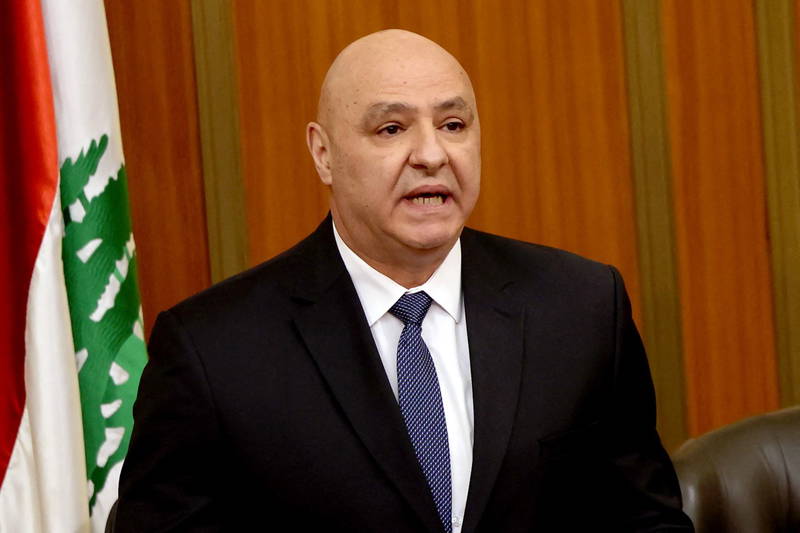
Picture: Lebanese President, Joseph Aoun
Lebanese President, Joseph Aoun has accused Iran of using Lebanon as a bargaining chip in its negotiations with the United States, saying Lebanese citizens are paying the price for conflicts that serve Tehran’s interests rather than their own.
In an interview with Christiane Amanpour, Aoun said the Lebanese people are exhausted by decades of conflict involving Israel and the Iran-backed militant group Hezbollah.
“We are fed up and we want to live in peace,” Aoun said, stressing that Lebanese citizens deserve security and should not have to watch their homes destroyed every few years by recurring wars.
Direct Message to Iran
In one of his strongest public criticisms of Tehran, Aoun said Iran’s interests do not align with those of Lebanon.
Addressing Iran’s powerful Islamic Revolutionary Guard Corps, he declared: “It’s not your country, it’s our country,” accusing Iran of leveraging Lebanon in its negotiations with Washington.
According to Aoun, Lebanese civilians are bearing the consequences of regional power struggles while Iran pursues its own strategic objectives.
Push for Peace with Israel
The Lebanese president revealed that his government is prepared to engage in direct negotiations aimed at ending hostilities with Israel, a move that would mark a significant shift in relations between the longtime adversaries.
“We are ready, we are willing, we are committed,” Aoun said regarding efforts to secure a lasting peace agreement.
He described the current moment as a rare opportunity for both Lebanese and Israelis to choose diplomacy over continued warfare, noting that populations on both sides have endured decades of conflict since 1948.
Hezbollah Rejects Disarmament
A major obstacle remains Hezbollah’s refusal to surrender its weapons before Israeli forces withdraw from Lebanese territory.
Hezbollah leader Naim Qassem recently denounced Lebanon-Israel negotiations as a form of surrender and said many Lebanese reject the proposed arrangements.
Aoun, however, argued that many Lebanese Shiites and other citizens are tired of war and want stability. In a rare criticism of Qassem, he insisted that Lebanon’s Shiite community should not be viewed solely through the lens of Hezbollah’s leadership.
Warning Against Military Solutions
Despite his criticism of Hezbollah, Aoun also rejected the idea that military force alone can eliminate the group.
He argued that Israel could not achieve its objectives solely through military operations because Hezbollah represents more than a military organization.
“Israel can invade the whole country, they can flatten the whole country, but they will never be able to achieve their objective,” he said, describing Hezbollah as an ideology as much as an armed movement.
Balancing Act
Aoun acknowledged the difficulty of disarming Hezbollah, warning that a direct confrontation could risk reigniting the kind of civil conflict that devastated Lebanon during its 15-year civil war.
Instead, he said he hopes dialogue and negotiations will eventually persuade the group to lay down its arms, although he admitted the process would be costly and challenging.
As Lebanon remains caught between Israeli military pressure and Iranian influence, Aoun said diplomacy remains the country’s best path forward.
Tags
Lebanon, Joseph Aoun, Iran, Hezbollah, Israel, Middle East, US-Iran Talks