
From The Nijasun Feature Desk
As Nigeria inches closer to another fiercely contested presidential election, political rivals who ordinarily trade accusations and counter-accusations have momentarily spoken with one voice: they want a peaceful 2027 election.
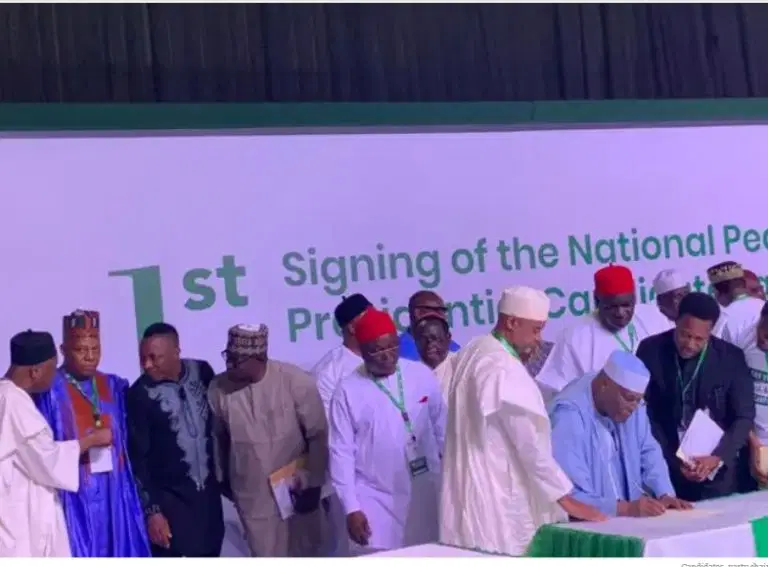
President Bola Ahmed Tinubu, Peter Obi and other presidential contenders have endorsed a peace accord committing political parties and candidates to issue-based campaigns and peaceful conduct throughout the electoral process.
The agreement, signed under the auspices of the National Peace Committee, comes as political activities gather momentum and Nigerians begin to brace for what promises to be another highly competitive presidential contest.
But beyond the ceremony, handshakes and carefully worded commitments lies a bigger question: will the politicians keep their promises when the real battle for votes begins?
A familiar promise
Peace accords are not new to Nigeria’s electoral politics.
Over the years, presidential candidates have repeatedly pledged to respect the rules of the game, avoid violence and accept the outcome of credible elections.
Yet, the history of Nigerian elections has shown that political campaigns can quickly become heated, particularly when candidates believe that victory is within reach.
The 2027 contest is already generating strong political emotions. With the ruling All Progressives Congress seeking to retain power and opposition forces hoping to wrest it away, the stakes are enormous.
The signing of the latest accord therefore represents more than a ceremonial exercise. It is an attempt to place a moral and political restraint on the contestants before the campaign season becomes fully charged.
The issues Nigerians want answered
For ordinary Nigerians, the real value of the accord will not be measured by the number of signatures appended to the document but by the quality of the campaigns that follow.
Millions of citizens are looking for answers to everyday problems: how to reduce the cost of living, create jobs, improve electricity supply, tackle insecurity, strengthen the naira, expand healthcare and education and make government more accountable.
That is why the call for issue-based campaigns has attracted particular attention.
Rather than turning political rallies into platforms for insults, ethnic mobilisation or religious sentiments, candidates are expected to tell Nigerians what they intend to do differently and, more importantly, how they intend to do it.
The 2027 election could therefore provide an opportunity for political parties to move beyond personalities and slogans and engage Nigerians on concrete policies.
Tinubu’s challenge
For President Tinubu and the APC, the 2027 election will be a referendum of sorts on the administration’s record.
The President’s supporters are expected to campaign on what they describe as the achievements and reforms of his administration, while opposition parties will likely focus on economic hardship, insecurity and other challenges confronting citizens.
The peace accord places an additional responsibility on the ruling party: to defend its record without using the machinery of government or political influence to intimidate opponents.
For Tinubu, a peaceful and credible election could become part of his democratic legacy.
Obi and the opposition question
For Peter Obi and other opposition candidates, the challenge is equally significant.
Obi has consistently campaigned around issues of governance, accountability, productivity and the need to make public resources work for citizens.
His participation in the peace process reinforces the expectation that his campaign should remain focused on policies rather than personal attacks.
But opposition parties also face the temptation of turning public anger into political mobilisation.
The real test will be whether they can criticise government strongly without allowing their supporters to cross the line into hate speech, misinformation or violence.
The Atiku factor
Former Vice President Atiku Abubakar remains another major figure in the political calculations surrounding 2027.
His political influence and long experience in presidential contests make his position particularly important to the opposition landscape.
However, his absence from the peace accord ceremony has already attracted attention.
Whether or not that absence has any broader political implication, Nigerians will expect every major contender to demonstrate commitment to peaceful politics, regardless of whether they sign a document in Abuja or make their commitment through their subsequent conduct.
Social media: The new battleground
Perhaps the greatest challenge to peaceful campaigning in 2027 will not come from traditional political rallies but from social media.
Political supporters can now create and circulate information capable of reaching millions of Nigerians within minutes.
A fabricated video, manipulated photograph or false election result can spread rapidly before authorities have an opportunity to establish the truth.
This makes responsible communication an important part of the peace agreement.
Candidates may control what they say at rallies, but controlling their supporters and online campaign networks will be considerably more difficult.
The question is whether political parties will discipline their own supporters when they cross the line.
Beyond the signatures
The National Peace Committee has warned that previous electoral cycles recorded breaches of similar commitments.
That history explains why many Nigerians are likely to view the latest accord with cautious optimism.
A peace agreement is only as powerful as the willingness of its signatories to obey it.
The real test will come when opinion polls turn against a candidate, when a provocative statement goes viral, when supporters believe their candidate has been cheated, or when preliminary election results begin to emerge.
Will the candidates call their supporters to order?
Will they reject inflammatory rhetoric even when it benefits them politically?
Will they accept defeat if the election is judged credible?
And will the winner resist the temptation to treat political opponents as enemies?
A test for Nigeria’s democracy
The 2027 election is not simply a contest between Tinubu, Obi, Atiku and other political personalities.
It is also a test of Nigeria’s democratic maturity.
A peaceful election will not mean the absence of disagreement. Democracy thrives on disagreement. The important question is whether Nigerians can disagree without killing, maiming, threatening or destroying one another.
The peace accord has provided the politicians with a platform to make their promise.
Now the country will be watching.
From the first campaign rally to the final declaration of results, Nigerians will have the opportunity to judge whether the signatures appended to the agreement were merely political theatre—or the beginning of a genuine commitment to a better way of conducting elections.
Ultimately, the responsibility does not belong to politicians alone.
The media, electoral bodies, security agencies, religious and traditional leaders, civil society organisations and, most importantly, voters all have roles to play.
The 2027 election may be fiercely contested.
It does not have to be bloody.
And that may be the most important promise contained in the peace accord.


