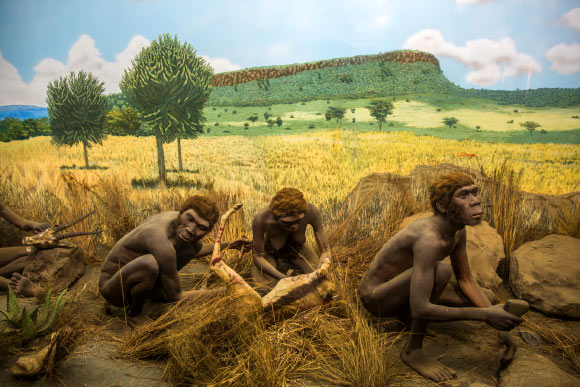
Pic: Archaic hominins. Image credit: Ninara / CC BY 2.0.
By Science Desk
A groundbreaking international study has revealed that every person alive today carries genetic material from two previously unknown ancient human groups, dramatically reshaping scientists’ understanding of human evolution.
The discovery, published in the prestigious journal Science, suggests that modern humans did not evolve in isolation but interbred with multiple ancient human populations over hundreds of thousands of years.
Until now, scientists had confirmed interbreeding only with Neanderthals and Denisovans.
The new research, led by scientists at the University of California, Berkeley, identified two mysterious “ghost” human lineages whose existence had remained hidden because no fossils or ancient DNA from them have ever been recovered.
Using a powerful new computational technique called TRACE (TRacking Archaic Contributions via ARG Estimation), researchers reconstructed the evolutionary history buried within the genomes of hundreds of living people.
Instead of relying solely on ancient fossil DNA, the method traced inherited genetic patterns passed down through countless generations.
Two Unknown Human Lineages
The first newly identified lineage lived in Africa and is believed to have interbred with anatomically modern Homo sapiens more than 50,000 years ago, before humans migrated in large numbers into Europe and Asia.
Scientists estimate that this mysterious population separated from the human family tree about 800,000 years ago, roughly when the ancestors of Neanderthals and Denisovans branched away.
Surprisingly, the study found that every modern human—whether African, European, Asian or from any other part of the world—has inherited DNA from this ancient population.
Researchers estimate that between 0.5 and 1 percent of every person’s genome comes from this previously unknown human lineage.
Lead researcher Yulin Zhang said earlier studies had hinted at the existence of an unidentified ancient population, but the new research is the first to demonstrate that its genetic legacy exists in all modern humans.
An Even Older Human Relative
The second discovery is even more astonishing.
Researchers found evidence of a “super-archaic” human lineage that dates back approximately 1.8 million years, making it one of the oldest known branches of the human family.
Unlike the African ghost lineage, this ancient population did not mate directly with modern humans. Instead, scientists believe it interbred with Denisovans in Eurasia.
Later, when Denisovans mixed with modern humans, fragments of this incredibly ancient DNA were passed on to future generations.
Today, traces of this super-archaic ancestry are most common among people from Oceania, whose populations are already known to possess relatively high levels of Denisovan ancestry.
Ancient DNA Still Benefits Humans
Overall, the researchers estimate that nearly 2 percent of the modern human genome originates from these two newly discovered ancient human populations.
More importantly, many of these inherited genes are concentrated in regions associated with immunity, metabolism and adaptation, suggesting they may have helped early humans survive unfamiliar diseases, changing climates and new food sources as they spread across the globe.
According to co-author Dr. Priya Moorjani, interbreeding with other ancient human groups introduced valuable genetic variations that natural selection preserved because they improved the chances of survival.
A New Chapter in Human Evolution
The findings add another layer to the increasingly complex story of human origins.
For decades, scientists believed modern humans largely replaced other ancient human species. Recent discoveries have shown instead that ancient human populations repeatedly met, interbred and exchanged genes, leaving lasting biological signatures that remain in people today.
The researchers believe even more unknown human lineages may be discovered as genome databases expand to include more diverse populations from around the world.
They also hope future fossil discoveries, including protein evidence recovered from Homo erectus, could eventually identify the mysterious super-archaic population whose DNA still survives in humanity.
The study marks one of the most significant breakthroughs in human evolutionary genetics in recent years, demonstrating that the story of human origins is far more interconnected—and far more mysterious—than previously believed.
Tags: Human Evolution, DNA Research, Ancient Humans, Science, Genetics