
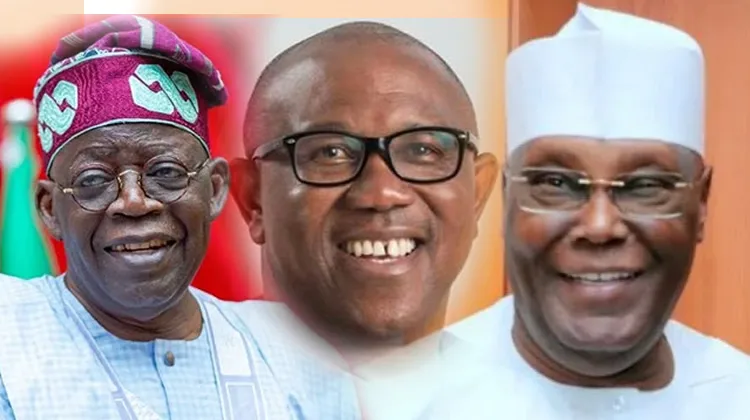
Picture: L-R: Tinubu, Obi and Atiku
From The Nijasun Feature Desk
The battle for Nigeria’s presidency in 2027 has begun, but on the opening day, President Bola Ahmed Tinubu, former Vice President Atiku Abubakar and former Anambra State governor Peter Obi chose remarkably different paths to make their voices heard.
Rather than a single dramatic launch or crowded presidential rally, Daily Trust reports, the first day of the campaign offered something more revealing: three political figures attempting to define the election on their own terms.
For Tinubu, governance remained the centre of attention. Atiku went straight for the economic policies of the incumbent administration. Obi, meanwhile, asked Nigerians to look beyond campaign promises and judge the contenders by their records, competence and character.
Tinubu: Campaigning from the seat of power
Tinubu entered Day One with an advantage his two major challengers do not have-he is already in the presidential seat.
While the campaign officially opened, the president was at the State House in Abuja, presiding over a Federal Executive Council meeting, his first since June 29.
The choice was symbolic.
As his opponents began selling their visions to voters, Tinubu projected the image of a president still focused on the business of governing the country.
The government highlighted decisions on education, infrastructure and the economy. Among them was Tinubu’s directive that liquid funds recovered by the Economic and Financial Crimes Commission be channelled into the Nigerian Education Loan Fund.
But behind the official activities lies a bigger political question: can Tinubu persuade Nigerians to endure the pain of his reforms in the hope of enjoying their long-term benefits?
The removal of petrol subsidy and reforms in the foreign exchange market remain among the most controversial decisions of his administration.
Supporters argue that the reforms were necessary to rescue the economy, while critics point to rising living costs and declining purchasing power.
That debate is almost certain to dominate the president’s re-election campaign.
Atiku: Turning economic hardship into a campaign weapon
If Tinubu’s opening day was about defending the record of an incumbent, Atiku’s was about challenging it.
The ADC presidential candidate took his message directly to Nigerians through a Facebook Live session, placing the controversial petrol subsidy at the heart of his opening campaign pitch.
Atiku promised to restore the subsidy if elected, directly challenging one of the defining economic policies of the Tinubu administration.
He also questioned what became of the savings generated by subsidy removal and argued that Nigerians deserved greater evidence of the benefits of the policy.
His campaign also raised questions over approximately N30 trillion in Federation revenues, deductions, savings and transfers which he said required transparent reconciliation.
It was a clear opposition strategy: take the pain Nigerians feel in their daily lives and turn it into an argument for political change.
Obi: The battle for competence
Peter Obi took a different route.
Rather than leading with a promise to reverse a particular government policy, the Labour Party candidate urged Nigerians to examine the people seeking their votes.
His campaign described him as the “Candidate of Conscience” and called on voters to use the 150-day campaign period to scrutinise the records, character, competence and policy proposals of the presidential candidates.
Obi’s message was built around familiar themes: moving Nigeria from consumption to production, reducing the cost of governance, improving education and healthcare, strengthening security and creating economic opportunities.
His strategy appears designed to shift the conversation away from political personalities and party structures towards performance and economic productivity.
The battle ahead
The contrasting opening approaches may offer an early indication of how the 2027 presidential contest will unfold.
Tinubu will have to defend the record of his administration while convincing Nigerians that his reforms will ultimately deliver economic stability.
Atiku will seek to turn public frustration into support for a change of direction, with subsidy restoration already emerging as a major campaign promise.
Obi, meanwhile, will attempt to make competence, accountability and productivity the defining issues of the election.
The three candidates are therefore entering the race with three distinct political narratives: continuity, change and competence.
But campaign messages alone will not determine the winner.
Between now and the January 16, 2027 presidential election, the candidates will have to convince millions of Nigerians that their promises are realistic, their records are credible and their visions can deliver a better country.
The opening day has only fired the starting gun. The real battle has just begun.
Tags: 2027 Election, Tinubu, Atiku, Peter Obi


