By Chinedum Treasure
A civil society organisation, Heir Women Hub, has renewed calls for deliberate and sustained efforts to bridge the gender gap in leadership, following a Focus Group Discussion (FGD) held on March 26, 2026.
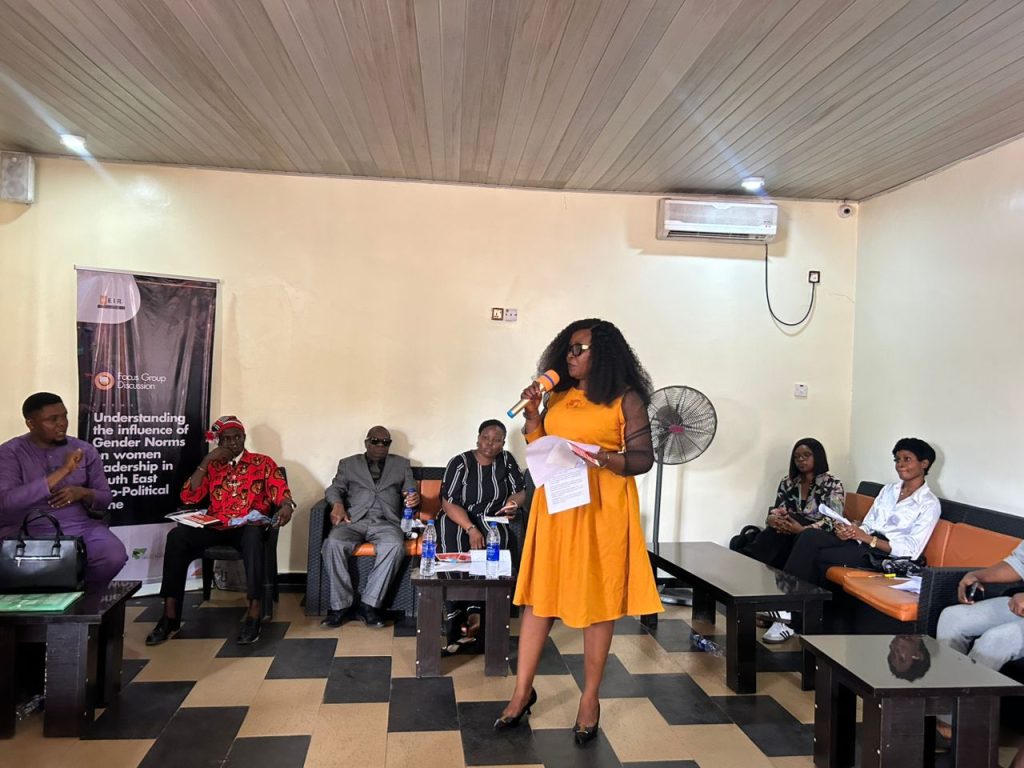
The session, themed “Understanding the Influence of Gender Norms on Women’s Leadership in the South-East Geo-Political Zone of Nigeria,” brought together key stakeholders to examine cultural, social, and institutional barriers limiting women’s participation in leadership across the region.
Providing an overview, the organisation’s Executive Director, Añuli Aniebo, described women’s representation in Nigeria’s political leadership as “critically low.” She noted that women currently make up only 3.7 percent of the Senate and 4.4 percent of the House of Representatives—amounting to just 20 out of 469 members of the National Assembly.
According to her, the situation is equally concerning across the South-East states—Ebonyi, Enugu, Anambra, Abia, and Imo—where only five women serve in State Houses of Assembly. Notably, Abia and Imo states currently have no female legislators.
In the executive arm, representation remains limited, with only two female deputy governors in the region—Chinyere Ekomaru and Patricia Obila.
Participants at the discussion identified multiple challenges hindering women’s advancement into leadership roles. These include societal expectations, cultural norms, and institutional barriers that often subject women to heightened scrutiny both in public and private life.
They observed that traditional gender roles—particularly expectations that women prioritize caregiving and domestic responsibilities—continue to discourage active participation in leadership. Such pressures, they said, often erode confidence and limit ambition.
The forum also highlighted structural issues such as limited access to education, financial constraints, and persistent cultural biases. Contributors noted that women in leadership frequently face stereotypes, criticism, and social pressures, including discrimination and tensions within personal relationships.
Religious and cultural influences were also identified as significant factors, with some interpretations reinforcing male dominance and discouraging support for female leadership.
Despite these challenges, stakeholders emphasized education as a critical driver of empowerment. They agreed that increased access to education can enhance women’s decision-making capacity, strengthen advocacy, and improve participation in governance and community development.
Heir Women Hub reiterated that inclusive leadership is essential for balanced policymaking, improved social outcomes, and sustainable democratic growth. The organisation called for targeted support for women candidates, inclusive political reforms, investment in leadership development, and sustained advocacy for gender equity.
The session concluded with a collective call for government, civil society organisations, and community leaders to intensify efforts toward increasing women’s representation in leadership across the South-East and Nigeria at large.
Tags:
Gender Equality, Women in Leadership, South-East Nigeria, Nigerian Politics, Heir Women Hub, Governance, Women Empowerment, Gender Norms, Political Representation, Civil Society, Nigeria News, Leadership Development, Inclusion, Democracy