
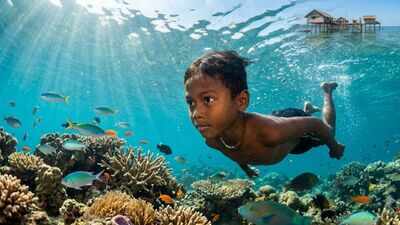
Pic: AI generated
From The Nijasun News Desk
Scientists have uncovered one of the most fascinating examples of human adaptation after discovering how the Moken sea nomads of South-East Asia developed the extraordinary ability to see underwater almost as clearly as dolphins.
The Moken, an Indigenous community living along the coasts and islands of Thailand and Myanmar, have depended on the sea for survival for generations.
From an early age, their children dive beneath the water to gather shellfish, sea cucumbers and other marine resources, spending countless hours underwater.
According to The Times of India, unlike most people, whose vision becomes blurred underwater because the human eye is designed to focus light in air, Moken children can clearly identify tiny objects beneath the surface.
Researchers found that they achieve this by naturally constricting their pupils more than usual and adjusting the lenses of their eyes to improve focus while submerged.
What surprised scientists most was that this remarkable ability is not genetic.
Instead, it is acquired through years of practice and constant exposure to underwater environments during childhood.
Studies also showed that children from other populations could significantly improve their underwater vision after undergoing similar training, proving that the human eye is far more adaptable than previously believed.
Scientists say the discovery demonstrates the incredible capacity of the human body to adapt to environmental demands. It also provides fresh insights into how lifestyle and early-life experiences can shape sensory abilities that once seemed impossible for humans.
The findings have attracted global attention, with researchers describing the Moken as one of the world’s most remarkable examples of human adaptation to nature, offering valuable lessons about the untapped potential of the human body.
Tags: Science, Human Biology, Moken Sea Nomads, Marine Discovery, Research