
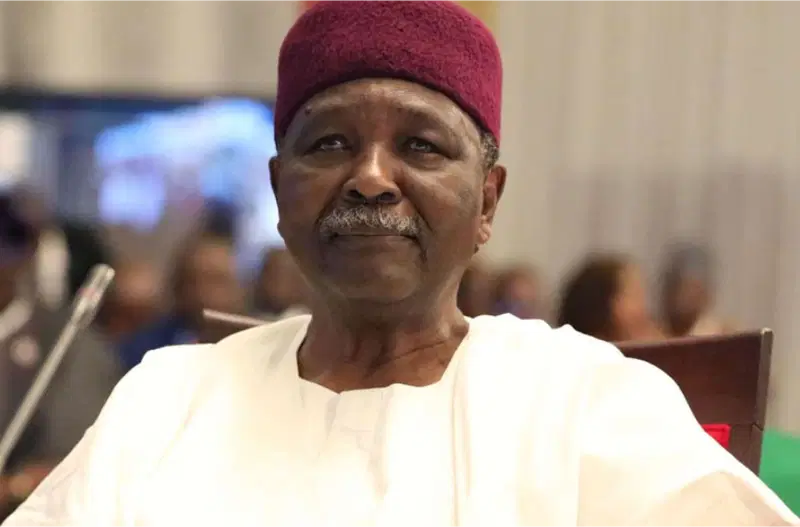
Former Nigerian Head of State, Yakubu Gowon has accused late Biafran leader, Chukwuemeka Odumegwu Ojukwu, of frustrating repeated efforts to prevent the Nigerian Civil War, saying all peaceful attempts to keep the country united were undermined by Ojukwu’s actions, Vanguard reports.
In his autobiography, My Life of Service and Allegiance, Gowon revisited the tense political atmosphere that followed the 1966 coups and the killings of Igbos in parts of Northern Nigeria, events that deepened distrust and pushed the country toward conflict.
According to Gowon, the Federal Military Government entered the January 1967 Aburi meeting in Ghana with genuine intentions to find a peaceful political settlement capable of preserving Nigeria’s unity.
“We went to Aburi with open minds and with the sincere hope of finding a basis for national reconciliation,” Gowon stated.
The meeting, facilitated by former Ghanaian leader, Lt.-Gen. Joseph Arthur Ankrah, brought together Nigeria’s top military officers amid growing ethnic tension and fears of national collapse.
However, Gowon claimed the talks later broke down because both sides returned with conflicting interpretations of the agreement reached in Aburi.
He alleged that Ojukwu’s understanding of the accord would have drastically weakened the authority of the Federal Government and endangered Nigeria’s survival as one country.
“What was presented by Ojukwu as the Aburi Accord was, in reality, his own interpretation of our discussions,” Gowon wrote.
The former military ruler maintained that despite rising tensions, his government continued to pursue peaceful solutions and resisted military confrontation for as long as possible.
“At every stage, we tried to preserve Nigeria without resorting to war,” he said.
Gowon also acknowledged the fear and trauma experienced by Eastern Nigerians following the massacres of Igbos in parts of the North after the failed coups of 1966, admitting that the killings complicated reconciliation efforts.
“I understood the fears of the Easterners. But the breakup of Nigeria was never an option I could accept,” he added.
He defended the creation of 12 states by the Federal Government shortly before Biafra’s declaration, describing it as an effort to protect minority ethnic groups and reduce fears of regional domination.
According to him, several minority communities within the old Eastern Region desired direct recognition from the Federal Government and feared political marginalisation.
“The creation of states was intended to give all groups a sense of belonging within Nigeria,” Gowon explained.
The former Head of State further insisted that the Federal Government did not seek war, arguing that the declaration of Biafra on May 30, 1967 left the government with limited options.
“Ojukwu’s declaration of Biafra left the federal government with no choice,” he wrote.
Gowon also defended the post-war “No Victor, No Vanquished” policy introduced after the Civil War ended in January 1970, saying it was necessary for reconciliation, reintegration and national healing after years of bloodshed.
“We fought to keep Nigeria one, not to destroy a people,” he stated.
While Ojukwu maintained until his death in 2011 that Biafra emerged out of necessity due to the failure of the Nigerian state to protect Easterners, Gowon’s memoir presents a different perspective, placing responsibility for the collapse of peace negotiations largely on the late Biafran leader.
“We exhausted every peaceful avenue available to us. But Nigeria had to survive,” Gowon concluded.
Tags: Yakubu Gowon, Chukwuemeka Odumegwu Ojukwu, Aburi Accord, Nigerian Civil War, Biafra, Nigeria, 1966 Coup, Eastern Region, Federal Military Government, National Reconciliation, State Creation, Nigerian Politics, Nigerian History,