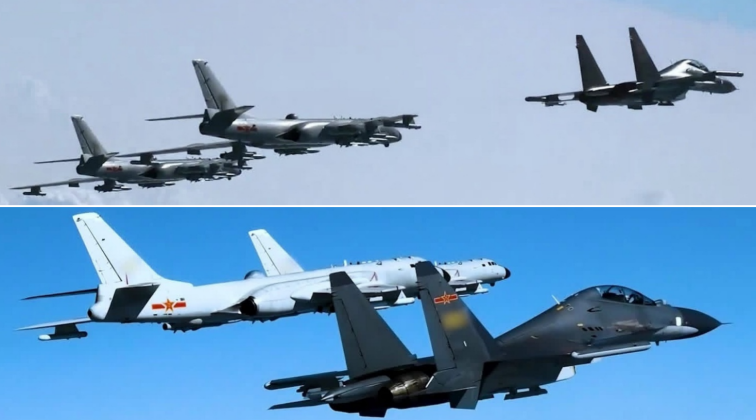
China’s People’s Liberation Army (PLA) Navy has deployed its Russian-supplied Sukhoi Su-30MK2 fighter jets to escort Xian H-6 bombers during a military patrol over the disputed Huangyan Island in the South China Sea.
The operation was seen as a strong display of Beijing’s military presence and control over the strategically important island, which remains a major flashpoint in regional territorial disputes.
According to reports, the Su-30MK2 fighters were armed with Russian-made R-77 air-to-air missiles and China’s YJ-91 anti-ship cruise missiles, while the H-6 bombers carried heavier YJ-12 anti-ship missiles for maritime strike missions.
China acquired 24 Su-30MK2 aircraft from Russia in 2004 specifically for naval operations. At the time, the fighter jets were regarded as among the most advanced combat aircraft in Chinese service.
The Su-30MK2 variant was specially designed for the PLA Navy with enhanced radar systems, improved surveillance capabilities, and stronger maritime strike functions.
Despite being considered outdated for modern air combat compared to newer Chinese fighters, the aircraft still remains effective as a long-range cruise missile carrier.
China has since developed more advanced indigenous fighters such as the Shenyang J-16 and Shenyang J-15B, while the navy has also begun operating the fifth-generation Shenyang J-35 stealth fighter.
Military analysts believe the J-35 could eventually replace older fighters like the Su-30MK2 in Chinese naval aviation units as Beijing continues expanding its military reach in the Asia-Pacific region.
Tags: China, South China Sea, Su-30MK2, H-6 bomber, Huangyan Island, PLA Navy, Chinese military, Russia, J-35 fighter jet, Asia-Pacific security, military aviation, cruise missiles