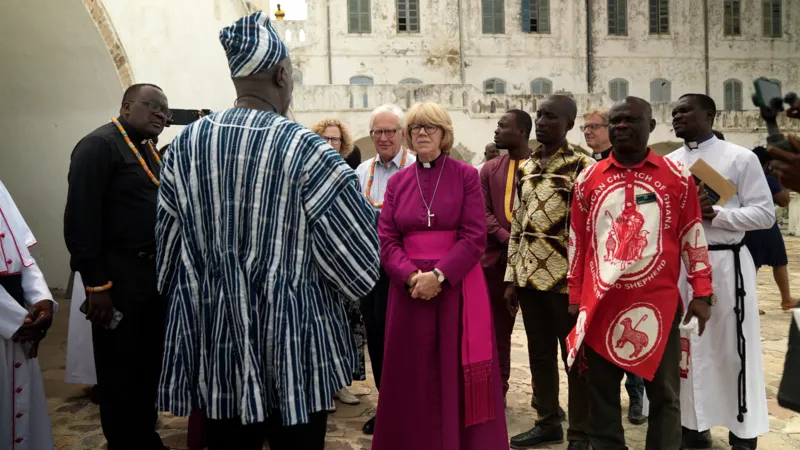
Dame Sarah Mullally pledged her support to the fund on a trip to Ghana
From The Nijasun News Desk
The Archbishop of Canterbury, Dame Sarah Mullally, has reaffirmed the Church of England’s commitment to a controversial £100 million reparative justice fund aimed at addressing the Church’s historical involvement in the transatlantic slave trade.
Speaking during a visit to the historic Cape Coast Castle in Ghana, where thousands of enslaved Africans were imprisoned before being transported across the Atlantic, according to BBC report, Dame Sarah said the Church must match repentance with meaningful action.
“We played a part in the transatlantic slave trade. That is clear. Part of the Christian belief in repentance is about action, so we are putting in place action to support those communities that feel the legacy of the slave trade,” she said.
The visit marked Dame Sarah’s first pastoral trip to Africa since she assumed office as head of the Church of England in March.
Touring the slave dungeons and the infamous “Door of No Return,” she described the experience as deeply moving.
“You can’t help but be deeply moved by the horrific conditions that people were kept in and the way that they were treated.
“It completely throws you off balance and brings home the evil that was transatlantic slavery,” she added.
She also highlighted the painful symbolism of a chapel built directly above the slave dungeons, describing it as a stark reminder of the Church’s historical complicity in the slave trade.
The Church of England has previously apologised for its links to slavery.
Historical records show that its missionary arm operated slave-worked plantations in the Caribbean, some clergy owned enslaved people, and the Church received financial donations from slave traders.
Three years ago, the Church approved the establishment of the £100 million fund following an audit that uncovered significant historical investments linked to companies involved in the trafficking of enslaved Africans.
The fund is intended to support research, investment and engagement programmes benefiting communities still affected by the enduring legacy of slavery.
The initiative, however, has faced opposition from some within and outside the Church, with critics questioning the historical evidence, legal basis and ideological justification for the reparations programme.
Ghana, which has emerged as a leading advocate for global reparations, welcomed the Archbishop’s renewed commitment.
Ghana’s Foreign Minister, Samuel Okudzeto Ablakwa, praised Dame Sarah’s stance, saying it would send a powerful message to critics of the initiative.
“What the Archbishop of Canterbury is doing in Ghana will begin to send the right signals. Those who are revisionists or obstructionists within the Church of England are going to start thinking twice,” he said.
He added that Christianity teaches repentance through acknowledgment of wrongdoing, insisting that genuine reconciliation requires admission of past sins.
Tags: Church of England, Archbishop of Canterbury, Ghana, Slavery Reparations