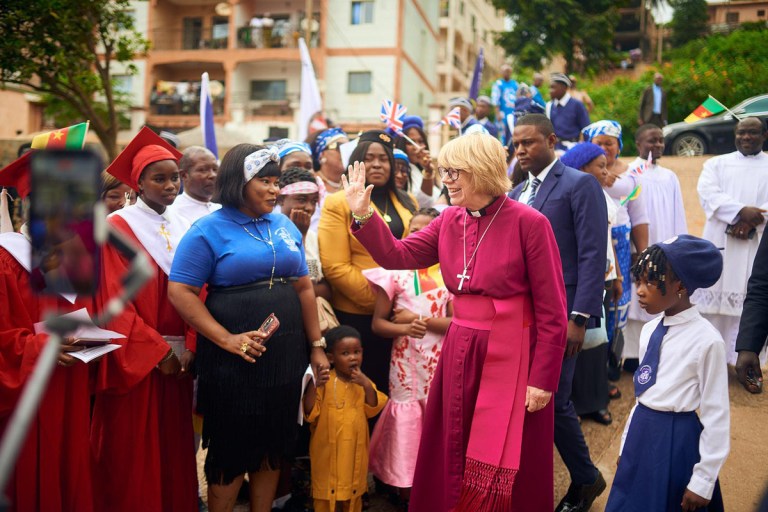
Pic: Archbishop of Canterbury Sarah Mullally arrives at a farewell service Aug. 4 in Yaoundé, Cameroon. Photo: Kini Wolfgang/Lambeth Palace
From The Nijasun News Desk
The Archbishop of Canterbury, Sarah Mullally, has called for peace, healing and reconciliation in Africa while reaffirming the Church of England’s commitment to addressing its historic links to the transatlantic slave trade.
Mullally made the call, according to Episcopal News Service, at a farewell service in Yaoundé, Cameroon, on Tuesday, August 4, marking the end of her 10-day visit to Ghana and Cameroon.
“Our world cries out for healing. Millions of people live in fear. Millions are displaced. Hundreds of children do not have access to school,” Mullally said in her sermon, noting that the people of Cameroon had suffered for too long.
The visit was Mullally’s first trip to Africa since her installation as Archbishop of Canterbury on March 25. She is the first woman to hold the position and also the first Archbishop of Canterbury to visit Cameroon.
She spent July 26 to 31 in Ghana before travelling to Cameroon, where she stayed until August 4.
While Ghana is regarded as one of West Africa’s more stable democracies, Cameroon continues to face armed conflict involving government forces and separatist groups from the country’s historically marginalised Anglophone regions.
Mullally praised peace-building cooperation involving the Anglican and Catholic churches as well as other Christian denominations and faiths in Cameroon.
She explained that lasting peace would require genuine and inclusive dialogue involving all relevant stakeholders.
“That requires courage, it requires strength, and it requires commitment at every level of society, but particularly those in authority,” she said.
The archbishop’s visit to Ghana also focused strongly on the Church of England’s efforts to address its historical involvement in the transatlantic slave trade.
During her visit to the Cape Coast Castle in Ghana on July 30, Mullally defended the church’s £100 million reparations fund, which was established to support communities affected by the legacy of slavery.
The fund was announced in January 2023 following an independent audit which found that an 18th-century church endowment, Queen Anne’s Bounty, had invested heavily in and profited from a slave-trading company.
The audit also found historical links between the church, slave plantations in the Caribbean, clergy who owned enslaved people and donations received from slave traders.
Mullally toured the dungeons where enslaved Africans were held before being transported to the Americas through what is popularly known as the “door of no return.”
She said witnessing the conditions in which enslaved people were held made it impossible not to feel the weight of the evil associated with the transatlantic slave trade.
She prayed for healing, justice and reconciliation for communities that continue to experience the consequences of the slave trade.
The reparations fund is expected to operate through 2032, supporting investment, research and aid programmes for communities affected by the slave trade.
However, questions remain over how beneficiaries will be identified and how the money will ultimately be distributed.
Retired Anglican Bishop Julius Kalu of Mombasa questioned how descendants and communities affected by the slave trade would be identified after several centuries.
However, African voices have largely welcomed the Church of England’s initiative, while calling for more substantial action.
Jackie Makena, a young theologian from the Methodist Church in Kenya, described the acknowledgement as welcome but stressed that recognition alone was not justice.
She argued that the legacies of slavery and colonialism remain visible in structural inequalities, economic disparities and unequal global power relations.
Adebayo Anthony Kehinde, an evangelist with the Nigeria African Church, also welcomed the apology but said many ministry leaders considered the £100 million commitment inadequate in view of the scale of the church’s historical involvement in the slave trade.
The independent oversight group that conducted the Church of England’s audit had recommended reparations of £1 billion or more, reflecting what it described as the moral gravity of slavery.
Kehinde further urged European churches to review statues and plaques honouring individuals who accumulated significant wealth through slavery, suggesting that historical context should be provided or such tributes relocated or renamed where appropriate.
The Archbishop’s Africa tour comes amid growing international calls for greater recognition of the historical consequences of slavery and colonialism, including demands for reparations, investment and the return of cultural artefacts taken from Africa.
Tags: Archbishop of Canterbury, Church of England, Transatlantic Slave Trade, Africa