From The Nijasun Feature Desk
As Nigeria moves closer to the 2027 general election, the contest for the presidency is increasingly becoming a battle not only over political alliances and electoral calculations, but also over the performance records of those seeking to lead the country.
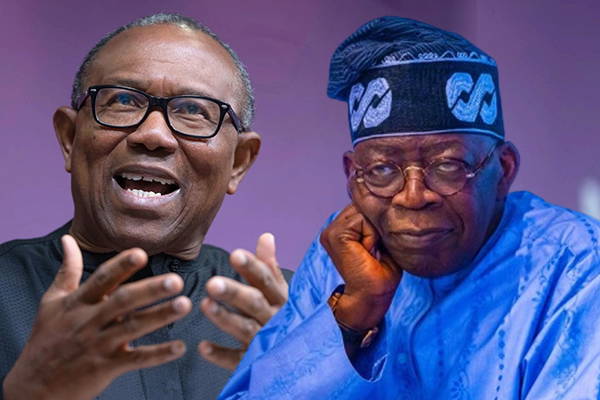
At the centre of that emerging debate is former Anambra State governor and Nigeria Democratic Congress (NDC) presidential candidate, Peter Obi, whose media office has mounted a fresh defence of his credentials while questioning the performance of President Bola Tinubu’s administration.
In a statement signed by Idris Zekeri Jnr, Obi’s media office argued that the former governor’s ambition was not based merely on political popularity but on what it described as his record in public administration, financial management, human-capital development and private-sector experience.
The argument provides another glimpse into the likely direction of the 2027 presidential campaign, where candidates are expected to increasingly place their records and policy choices before voters.
Obi’s Anambra Record
Obi’s political argument continues to draw heavily from his years as governor of Anambra State between 2006 and 2014.
His media office cited his re-election in 2010 as evidence of the political acceptance of his administration and cited what it described as fiscal discipline during his tenure.
It claimed that Anambra was among the least-indebted states during the period and that the administration accumulated substantial savings and investments.
The statement also referred to Obi’s 2023 manifesto, which documented about $500 million in investments and savings, including $156 million in dollar-denominated bonds.
For Obi’s camp, the significance of the figures goes beyond their monetary value. They are presented as evidence that a government can combine spending on development with saving and investment for the future.
Education also occupies an important place in the former governor’s performance narrative.
His media office recalled the return of mission schools to their original owners and partnerships established with them. It claimed that Anambra subsequently improved its position in WAEC/NECO performance, moving from 24th position to first for three consecutive years.
Scholarships, healthcare programmes, poverty mapping and other human-capital interventions were also cited as elements of the administration’s development strategy.
On healthcare, the statement claimed that more than 12 health institutions, including two hospitals, obtained accreditation by the end of Obi’s tenure, compared with none at the beginning.
Beyond Anambra
The defence of Obi’s credentials does not end with his record as governor.
His media office also drew attention to his background in business and banking, presenting it as an advantage in managing public resources and understanding the relationship between government policy and the economy.
Development partnerships involving the World Bank, UNDP, DFID and the European Union were also cited, alongside engagements with foreign governments.
The statement argued that Obi’s experience across the private and public sectors had equipped him with an understanding of financial management, institution-building and long-term planning.
The underlying message is that the presidency, in Obi’s case, would not represent an entry point into executive governance but an extension of experience already acquired at state and private-sector levels.
The Tinubu Question
While defending Obi, however, the statement devoted considerable attention to the performance of the Tinubu administration.
The media office identified what it described as 10 major failures, focusing principally on the economic difficulties confronting Nigerians.
The rising cost of living was placed at the forefront of the criticism.
According to the statement, the removal of the petrol subsidy and other economic reforms have been accompanied by significant increases in food, transportation and other essential costs.
It also directed attention to inflation and declining purchasing power, arguing that many incomes have struggled to keep pace with rising prices.
The depreciation of the naira was another major concern identified by Obi’s camp, particularly because of its impact on imported goods, medicines, machinery and industrial inputs.
The increase in petrol prices was similarly described as a major burden on households, businesses and transport operators.
For ordinary Nigerians, these economic issues have become more than policy statistics. They affect the cost of feeding families, moving around, running businesses and meeting basic household needs.
Jobs, Security and Public Trust
Beyond the economy, Obi’s media office raised concerns about unemployment, underemployment and the availability of productive opportunities for young Nigerians.
Security was another area of criticism, with the statement drawing attention to continuing cases of banditry, terrorism, kidnapping and communal violence in parts of the country.
It also questioned public confidence in government, citing controversies surrounding spending, appointments, procurement and the management of public resources.
The media office further alleged a gap between government promises and the experiences of ordinary citizens.
It questioned whether the difficult economic decisions taken by the Tinubu administration were producing sufficient benefits to justify the sacrifices being demanded from Nigerians.
The Emerging 2027 Argument
At the heart of the political exchange is therefore a fundamental question: How should Nigerians measure presidential performance?
For Obi’s camp, the answer lies partly in the tangible records of those seeking power.
The former governor’s supporters point to savings, investments, education, healthcare and development planning in Anambra as evidence of what they regard as responsible governance.
The criticism of Tinubu, meanwhile, centres on the immediate economic pressures faced by citizens and the government’s ability to translate its reforms into improved living conditions.
The two arguments represent different sides of the same electoral question: whether Nigerians should judge government primarily by the difficulty of reforms undertaken, or by the conditions those reforms ultimately produce.
The Tinubu administration has consistently argued that it inherited serious economic problems and that difficult reforms were necessary to rebuild the economy.
Obi’s media office accepts that the country inherited difficulties but insists that the more important question is whether Nigerians are now better off.
“The fundamental question is not whether Tinubu inherited a difficult Nigeria. He did,” the statement said.
“The question is whether, after taking difficult decisions, Nigerians are better off today, and whether the government has convincingly demonstrated that today’s sacrifice is producing tomorrow’s prosperity.”
With the 2027 election approaching, that question is likely to remain at the centre of the political conversation.
For voters, however, the ultimate test may be less about the claims made by political camps and more about measurable outcomes: the cost of living, jobs, security, infrastructure, access to education and healthcare, and the overall quality of life.
The emerging Obi-Tinubu debate is therefore more than another political exchange. It is becoming a contest over whose record offers Nigerians the more convincing promise of what the country can become.
Tags: Peter Obi, Bola Tinubu, 2027 Election, Nigeria Politics