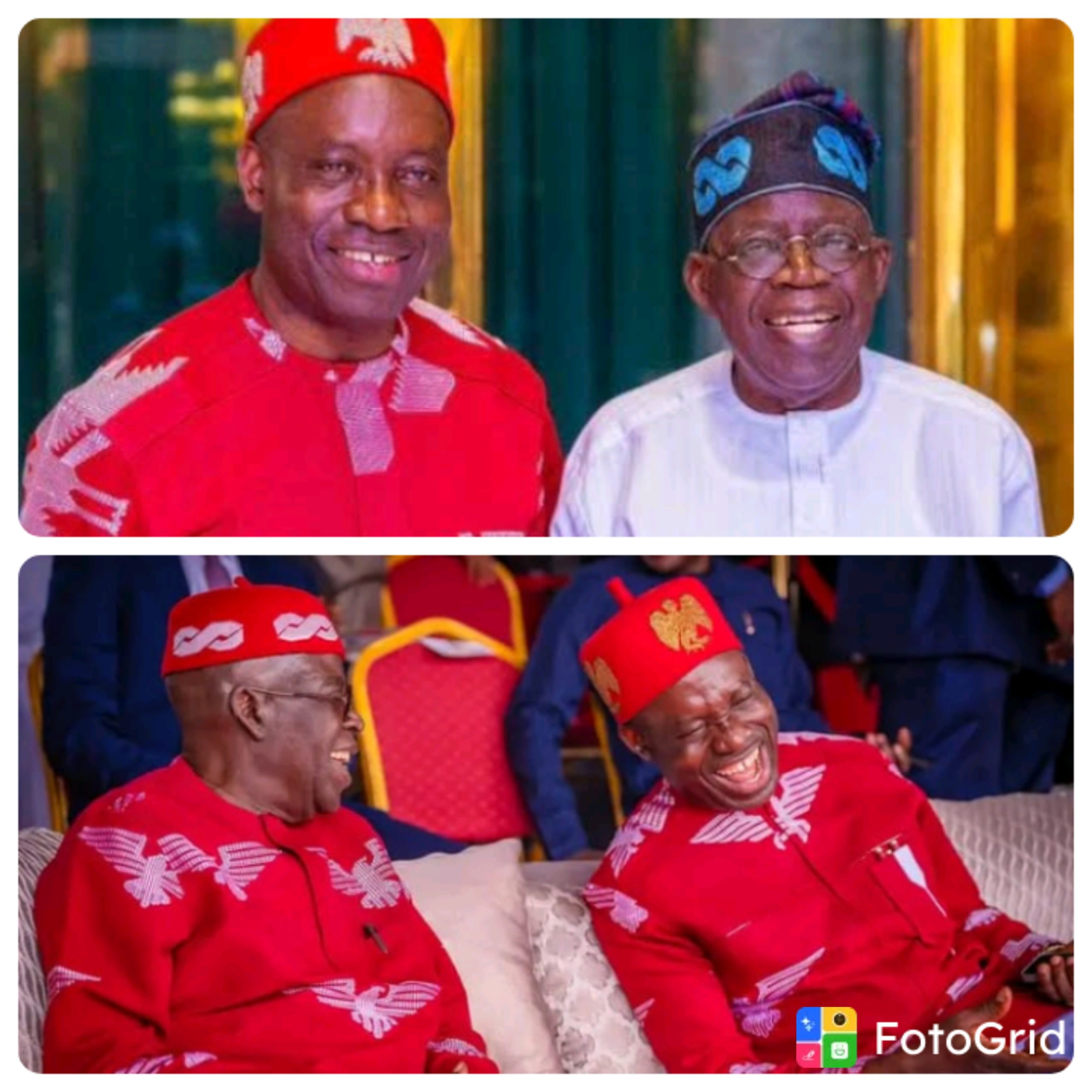
Pictures: President Tinubu and Gov Soludo
By Christian Aburime
There are defining moments in the life of a nation when policy moves beyond promises and becomes visible progress. Politics ceases to be a dividing line and transforms into a platform for collective development.
This week delivered one of those moments for Nigeria’s Southeast as President Bola Ahmed Tinubu, GCFR, approved two landmark federal road projects expected to revolutionise commerce, mobility and economic growth across the region.
The development drew glowing commendation from Anambra State Governor, Prof. Chukwuma Soludo, CFR, who described the approvals as a demonstration of responsive and inclusive leadership.
From Proposal to Presidential Approval in Just Two Weeks
The journey to the approvals reflects an uncommon speed in governance.
On July 1, 2026, Governor Soludo met President Tinubu and discussed the urgent need to reconstruct two strategic federal highways. Within 24 hours, the Minister of Works, Senator Dave Umahi, requested the technical details of the proposed projects. Two days later, the governor transmitted the required documentation.
By July 15, the President had approved both projects for design and procurement:
The 108-kilometre Otuocha–Anam–Abaji (Kogi) Road.
The 150-kilometre Oba–Nnewi–Uga–Ihube (Okigwe Junction) Road, linking Anambra and Imo States to the Enugu-Port Harcourt corridor through Abia State.
Both highways will be dualised, underscoring the Federal Government’s commitment to delivering modern transport infrastructure in the Southeast.
Responsive Leadership Beyond Politics
Beyond the scale of the projects, the speed with which they were approved has become one of the most remarkable aspects of the development.
Barely two weeks separated the governor’s meeting with the President from the final approval, reflecting a style of governance driven by urgency rather than bureaucracy.
The projects respond directly to the needs of traders, farmers, students, professionals and commuters whose daily lives depend on safe and efficient road networks.
More importantly, the approvals demonstrate governance that places national interest above political considerations.
Infrastructure That Connects Regions, Not Parties
The significance of the two highways extends far beyond Anambra State.
The roads will strengthen connectivity between the Southeast and the North Central through Kogi State, while also improving access to Abia, Imo, Enugu and the South-South economic corridor.
Rather than serving narrow political interests, the projects are designed to stimulate regional integration, boost trade and facilitate economic activities across multiple geopolitical zones.
In approving the projects, President Tinubu has reinforced the principle that national development should not be constrained by party affiliation or regional differences.
Roads as Symbols of National Inclusion
For the South-East, infrastructure carries a significance beyond concrete and asphalt. Given the region’s historical relationship with the Federal Government, major infrastructure investments also represent renewed confidence in national unity and inclusion.
Every kilometre of dual carriageway sends a powerful message that the Southeast remains an integral part of Nigeria’s development agenda and that its infrastructure needs are receiving deserved federal attention.
Soludo’s Regional Vision Takes Centre Stage
Equally noteworthy is Governor Soludo’s approach to development.
Neither of the approved highways lies entirely within Anambra State. Yet, he championed both projects because of their wider economic value to the Southeast.
His intervention reflects a broader regional outlook that recognises that Anambra’s prosperity is closely linked with the growth of neighbouring states, including Imo, Enugu, Abia, Ebonyi and Kogi.
The governor has consistently demonstrated that development is most impactful when pursued beyond state boundaries for the collective benefit of the region.
Collaboration Delivers Results
The approvals also highlight the importance of constructive engagement between the Anambra State Government and the Federal Government.
Supported by the Minister of Works, Senator Dave Umahi, Governor Soludo pursued collaboration rather than political confrontation.
As the governor has repeatedly stated, this is “why politics makes sense”—working across political divides to secure tangible benefits for the people instead of pursuing partisan interests.
It is a governance model measured not by political rhetoric but by completed infrastructure, improved connectivity and shared prosperity.
A New Chapter for the South-East
Taken together, the approval of the Otuocha–Anam–Abaji and Oba–Nnewi–Uga–Ihube highways represents far more than two federal road projects.
It reflects what can be achieved when visionary leadership, strategic collaboration and political goodwill converge in the public interest.
As design and procurement commence, the Southeast can look forward with renewed optimism to improved transportation, expanded commerce and stronger regional integration.
History, as Governor Soludo observed, may indeed remember President Bola Ahmed Tinubu as a leader who chose to build enduring infrastructure rather than merely make promises.
Tags: Tinubu, Soludo South-East Development, Road infrastructure, Anambra