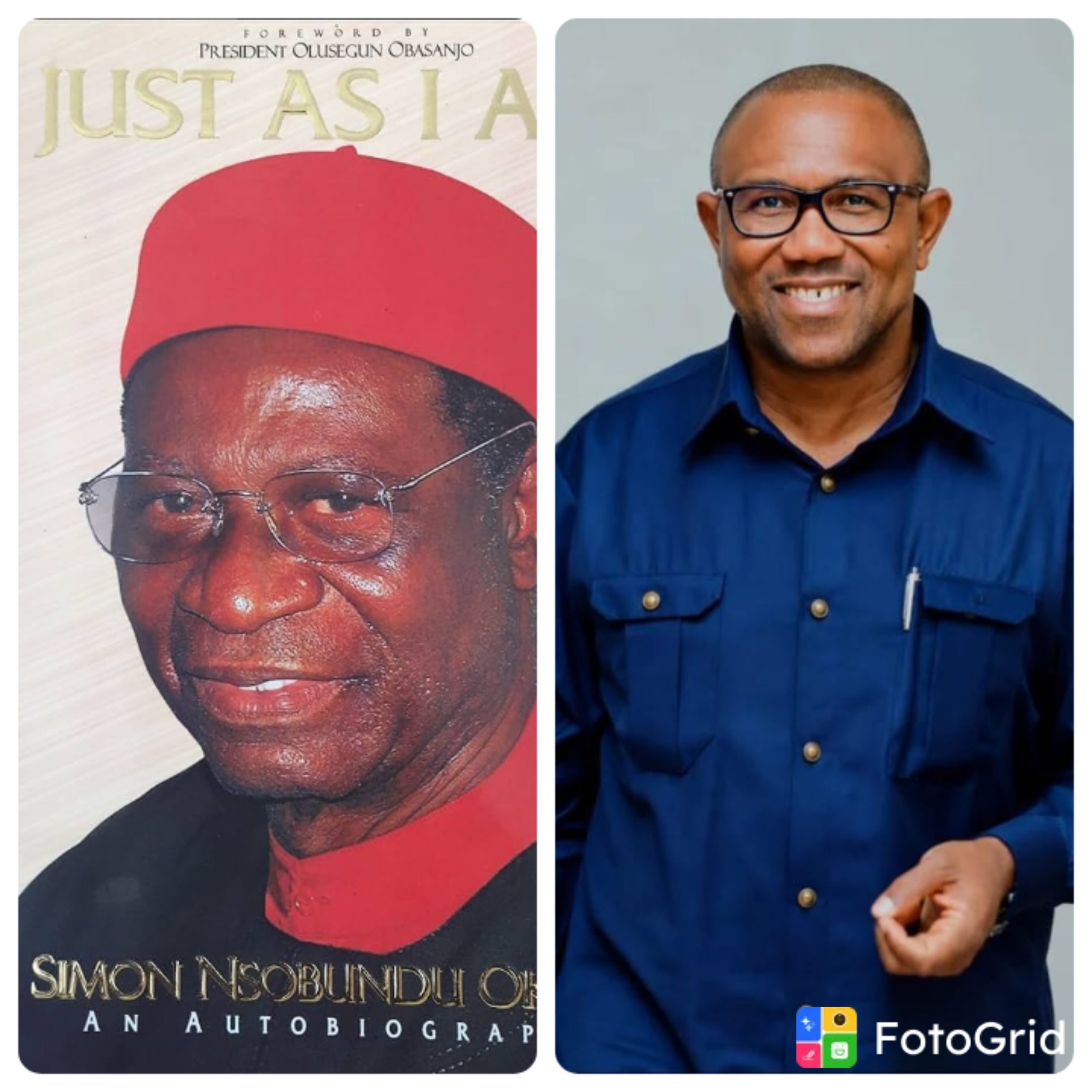
Picture: L-R: Chief Simon Okeke and Mr Peter Obi
By David Onwuchekwa
A provocative political declaration by Nigeria’s former Chairman of the Police Service Commission, Chief Dr Simon Nsobundu Okeke, traditionally known as Ochendo and Ami Amichi in Nnewi South Local Government Area of Anambra State, has continued to resonate in discussions about Igbo identity, political solidarity and the South-East’s quest for Nigeria’s presidency.
Chief Okeke, an elder statesman and prominent voice in Igbo affairs, once declared that anybody who claims to be Igbo but refuses to support Peter Obi’s presidential ambition should undergo a DNA test to establish whether the person is genuinely Igbo.
Although expressed humorously, the declaration was much more than a casual political joke. It was a strong message directed at what Okeke apparently considered a troubling contradiction. That is to say the inability of some Igbo people to recognise and support an opportunity that could advance the political fortunes of their ethnic nationality.
Indeed, his position deserves more than the dismissive treatment it sometimes receives. It raises a fundamental question about collective political interest. If Ndigbo have spent decades complaining about marginalisation, exclusion and the denial of access to Nigeria’s highest political office, what should their response be when one of their own emerges as a serious presidential contender?
This is the heart of Okeke’s argument.
For decades, the South-East has remained at the centre of conversations about political exclusion in Nigeria. Since the return to democratic government in 1999, the region has struggled to secure a stronger position in the country’s presidential power equation.
Despite its contributions to national development, commerce, education, industry and public service, the aspiration to produce a Nigerian president has remained largely unfulfilled.
The emergence of Peter Obi as a presidential candidate in 2023 therefore represented a historic political opportunity. For many Ndigbo, it was not simply about an individual seeking power. It was also about challenging the perception that the South-East could remain permanently outside the country’s highest political leadership.
Obi’s candidacy attracted considerable national attention, generated unprecedented enthusiasm among many young Nigerians and demonstrated that a candidate from the South-East could mobilise support beyond his immediate ethnic and geographical constituency.
Against this background, Okeke’s declaration becomes understandable. His concern appears to be that while other ethnic groups often demonstrate considerable political calculation in pursuing their collective interests, some Igbo political stakeholders are prepared to undermine their own opportunities because of party affiliations, personal ambitions, political disagreements, loyalty to politicians from other regions or for personal aggrandizement.
There is nothing wrong with political competition. However, there is something fundamentally troubling when a people who consistently demand inclusion cannot agree on how to maximise an opportunity that directly addresses one of their longstanding political aspirations.
The argument is not that every Igbo person must surrender his or her democratic freedom to support Peter Obi. Rather, it is that Ndigbo must learn to distinguish between ordinary partisan disagreements and strategic decisions that could have far-reaching consequences for their collective political future.
It is particularly difficult to understand a situation where people complain about the absence of an Igbo president but appear indifferent when an Igbo presidential candidate presents an opportunity to change that narrative.
What exactly do such people want? Must an Igbo presidential candidate first belong to their preferred political party, satisfy their personal political interests or obtain the endorsement of their political godfathers before they can recognise the significance of his aspiration?
These are legitimate questions that Okeke’s declaration forces Ndigbo to confront.
Political history demonstrates that ethnic nationalities and regional blocs often negotiate around common interests even when their members belong to different political parties. Such strategic calculations are not peculiar to the Igbo.
They are part of the realities of political competition in a country where numbers, alliances, negotiations and regional interests frequently determine access to power.
Why should Ndigbo be different?
If the South-East genuinely desires the presidency, its political leaders must develop a stronger sense of strategic coordination. They must understand that presidential opportunities are not secured merely by making emotional demands or lamenting historical injustices. They require preparation, political organisation, negotiation, alliances and, where necessary, compromise.
This is why Okeke’s position should not be dismissed as ethnic sentiment or an attempt to impose political allegiance. It is a challenge to the Igbo political establishment and the wider population to examine whether their political decisions are consistent with their collective aspirations.
Of course, being Igbo is not determined by support for any particular politician. No DNA test can establish political loyalty, and nobody should lose his or her ethnic identity because of a disagreement over Peter Obi or any other candidate.
But that does not invalidate the underlying message of Chief Okeke’s declaration.
There is a difference between the freedom to make individual political choices and the responsibility to recognise opportunities that could advance the collective interests of one’s people. A people can accommodate political differences without losing sight of their larger objectives.
Peter Obi himself has consistently presented his presidential ambition as a national project. His aspiration must therefore be evaluated within the wider Nigerian political environment, including his capacity to build alliances, attract support across the country and offer credible leadership.
Nevertheless, the fact that his ambition is national does not diminish the significance of the South-East having one of its own in the contest for the presidency.
The challenge before Ndigbo is to develop a political culture in which disagreements do not automatically translate into hostility towards opportunities for collective advancement.
Supporting an Igbo presidential aspirant should not be interpreted as abandoning critical thinking, just as questioning a candidate should not become an excuse for deliberately frustrating the legitimate political aspirations of an entire region.
Chief Simon Okeke’s declaration may sound extreme, but its underlying message is difficult to ignore. Ndigbo cannot continue to demand political justice while treating every opportunity to strengthen their bargaining position as an ordinary partisan contest.
The Igbo question is bigger than Peter Obi. It involves political inclusion, economic development, security, infrastructure, national representation and the capacity of the South-East to negotiate effectively within the Nigerian federation.
However, every major political aspiration requires practical steps towards its realisation. If Ndigbo want the presidency, they must be prepared to organise, negotiate and make strategic choices rather than allow internal divisions to continually weaken their position.
Be that as it may, the DNA test Okeke proposed may be a political metaphor, but the test of Igbo political consciousness is real.
It is a test of whether Ndigbo can look beyond personal interests, party affiliations and political rivalries to recognise and pursue opportunities that could advance their collective interests.
And on that question, Chief Simon Okeke’s controversial declaration deserves serious reflection.
Tags: Simon Okeke, Peter Obi, Ndigbo, Igbo Presidency, Nigerian Politics