
By Ukpa Ewa
Stakeholders have called for intensified action against disinformation, hate speech, voter apathy and electoral mistrust ahead of the 2027 general elections in Nigeria, warning that the growing spread of false narratives poses a serious threat to democratic participation and national cohesion.

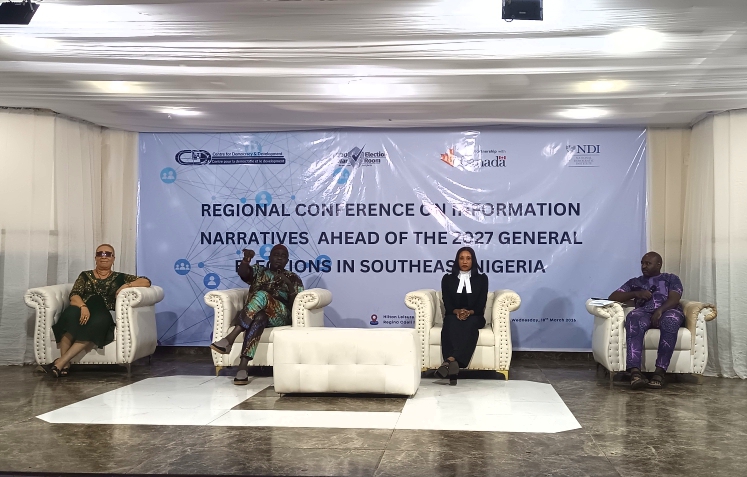
The call was made at a one-@day regional conference on information narratives held in Awka, Anambra State organized by the Center for Democracy and Development (CDD-West Africa) in partnership with the National Democratic Institute (NDI) bringing together civil society organizations, election stakeholders, security agencies, media professionals, religious leaders and grassroots representatives.

Speaking through election consultant Chibuike Mgbeahuruike, Director of CDD-West Africa, Dauda Garuba said the essence of the engagement was to identify and counter narratives capable of causing division among Nigerians. He warned that elections are increasingly being framed in conflict-like terms rather than democratic contests, explaining that disinformation and hate speech are already spreading across the political space, including narratives targeting the Independent National Electoral Commission.
He noted that CDD-West Africa is strengthening its fact checking systems and monitoring mechanisms, including a “war room” structure designed to track, analyse and counter false narratives in real time, identify their sources and push back with verified information.
Contributing during the panel session, the state Secretary of Inter Party Advisory Council, Uzochukwu Eminent, raised concerns over public trust in Nigeria’s electoral reforms. He argued that voter apathy remains a major challenge ahead of 2027 and questioned the credibility of assurances given during the 2023 general elections, particularly regarding technology and result transmission.
He warned that ongoing reforms and new regulatory requirements could further affect political participation if not properly managed, adding that confidence in the electoral process remains fragile.
In his submission, Venerable Jackson Onyeakagbusi identified poverty as a major driver of electoral manipulation, stating that economic hardship makes voters vulnerable to inducements during campaigns. He called on religious institutions, traditional rulers, media and the National Orientation Agency to intensify civic education and value reorientation, noting that many citizens prioritize immediate material benefits over long term democratic choices.
While the Managing Director of the Anambra State Civic and Social Reformation Office (ANCISRO), Sir Chuka Nnabuife, described the conference as a timely intervention ahead of 2027, stressing that Nigeria challenge is less about policy formulation and more about implementation. He called for stronger institutional collaboration and trust building between citizens and electoral bodies to reduce voter apathy and counter misinformation.
On his part, Chairman of the International Peace and Civic Responsibility Centre (IPCRC) Prince Chris Azor said corruption remains deeply entrenched in the system, urging collective responsibility to strengthen democratic institutions and ensure that information shared in the public space promotes unity rather than division.
The President General of Awka Market Women, Mrs. Virginia Okeke appealed for peaceful elections and urged political actors to prioritize grassroots welfare. She noted that ordinary citizens are more concerned with security and livelihoods than political rhetoric, while commending the organizers for including grassroots voices in the dialogue.
Officials of the Independent Corrupt Practices and Other Related Offences Commission, Inalegwu Shaibu and the Chairperson of International Federation of Women Lawyers, Barr. Amara Muojeke, also called for improved voter education, enhanced security assurance, better logistics and responsible media engagement to boost participation and reduce electoral apathy.
The conference, moderated by Deacon Alfred Ajayi and Dr. Henry Duru of the Department of Mass Communication, Nnamdi Azikiwe University, concluded with a consensus that the credibility of the 2027 elections will depend largely on the ability of institutions and stakeholders to curb misinformation, rebuild public trust and strengthen civic participation.


