
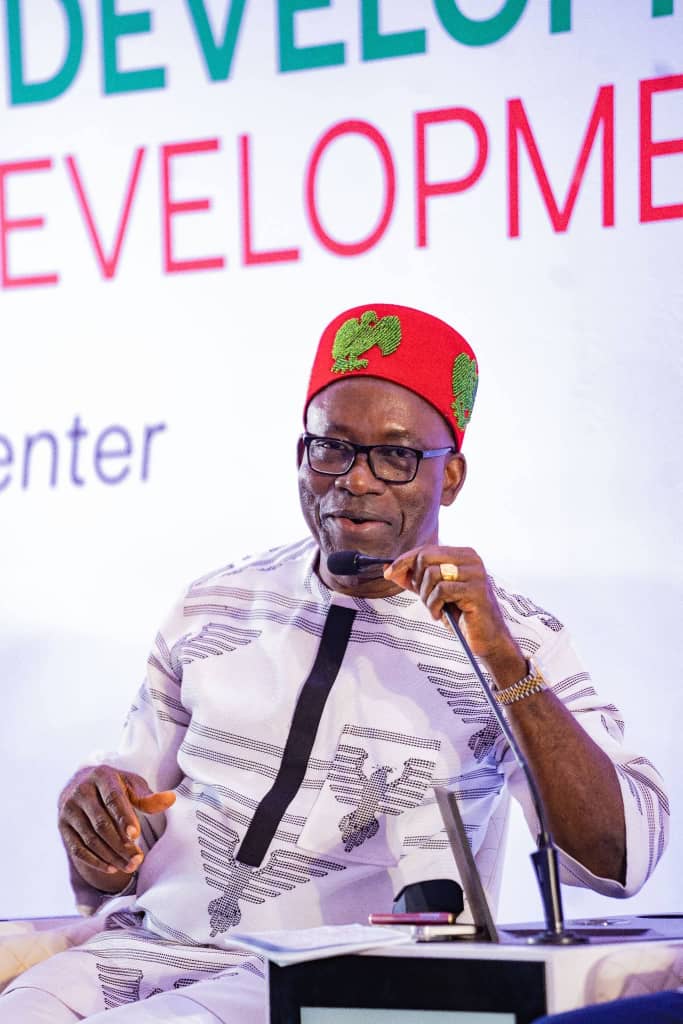
By Ebuka Onyekwelu, PhD
I have continued to follow with keen interest the political developments in the South-East ahead of the January 16, 2027, presidential and National Assembly elections.
While some commentators on social media insist that the South-East will vote overwhelmingly for the New Democratic Congress (NDC), the political realities across the region appear more complicated. There are indications that many people in the South-East are willing to work with President Bola Tinubu. Even among those who are dissatisfied with his style of leadership, some believe he should complete his second term and leave office at the end of it.
The notion that the NDC can easily dislodge President Tinubu through the ballot is not universally shared across the region.
More significantly, the NDC’s political visibility in the South-East appears concentrated in Anambra State. At first glance, one might attribute this to the fact that the party’s presidential candidate hails from the state. However, the situation is more complex than that.
The emergence of the African Democratic Congress (ADC) as another political platform also raises questions about the distribution of political influence across the region, particularly given the role of political alliances and the Rainbow Coalition associated with Nyesom Wike.
Across the other South-East states, several political figures who contributed to the Labour Party’s impressive performance in 2023 have since moved to other political platforms, with some joining the All Progressives Congress (APC).
In Enugu State, for instance, the NDC appears to have limited influence in the prevailing political equation. The political figures who once defined the Labour Party’s presence in the state have largely moved on, while some are now aligned with the APC.
In Imo State, the NDC has yet to establish a comparable political presence, despite the participation of prominent figures such as Senator Athan Achonu and Professor Sam Egwu in the state’s opposition politics in 2023.
Ebonyi State presents a different political picture, with the Peoples Democratic Party (PDP) featuring more prominently in the opposition space. In Abia State, too, the NDC has yet to demonstrate the kind of political visibility associated with the Labour Party’s performance in the previous general election.
Against this backdrop, Anambra State stands out as a particularly important political battleground.
Governor Charles Soludo has, in the view of his supporters, demonstrated considerable political tolerance by allowing opposition voices to operate in the state. The movement of politicians from the Labour Party to the NDC has also given the latter a measure of continuity in Anambra’s opposition politics.
Yet, despite this political environment, Soludo has continued to attract criticism from supporters of Peter Obi and the NDC.
This raises an important question: why has the governor become such a prominent target of criticism in Anambra, when opposition figures in some other South-East states face different political circumstances?
One possible explanation is that the NDC is seeking to consolidate the political support it enjoyed under the Labour Party in 2023 and translate it into a serious challenge to the All Progressives Grand Alliance (APGA) government in the next Anambra governorship election.
If that is the objective, then the intense political exchanges surrounding Soludo may reflect the strategic importance of Anambra to the NDC’s ambitions.
However, the governor’s supporters argue that the criticism directed at him overlooks the political space available to opposition groups in Anambra. They contend that Soludo has been more accommodating of his opponents than some of those opponents might have been towards APGA and its leadership in comparable circumstances.
The contrast is particularly striking when the political situations in Enugu and Imo are considered. Although opposition groups face different challenges in those states, criticism of Governors Peter Mbah and Hope Uzodimma has not necessarily taken the same form or attracted the same intensity of attention as the attacks on Soludo.
The larger political context cannot be ignored. The South-East governors have openly expressed support for President Tinubu, while opposition parties are working to strengthen their respective positions ahead of 2027.
In such a competitive environment, political alliances are often driven by the desire to win elections and secure influence.
Supporting a presidential candidate is not merely a symbolic gesture; it is also a strategic decision that can shape relationships between political parties, governments and their supporters.
It is therefore understandable that the political contest in Anambra has become particularly intense. But political disagreements should not obscure the distinction between legitimate criticism and personal attacks.
Soludo’s approach to opposition politics will ultimately be judged not by the volume of criticism directed at him, but by the evidence of how his government treats political opponents and how the democratic process unfolds in Anambra.
The political circumstances of 2023 are not the same as those of 2027. The Labour Party’s performance in the last general election does not automatically guarantee a similar outcome for the NDC, just as the movement of political figures between parties does not, by itself, determine how voters will behave.
For Soludo, the coming elections will provide another opportunity to test his political standing and the strength of APGA’s grassroots structures. His supporters maintain that his record as a distinguished economist and former Governor of the Central Bank of Nigeria gives him a political identity that cannot be reduced to the controversies surrounding him.
Those who question his political influence, on the other hand, will be looking for evidence that their criticism can translate into electoral support for their preferred candidates.
The August 2025 Anambra governorship by-election is one of the political developments observers may examine when assessing the changing balance of forces in the state.
However, the circumstances of a by-election and those of a general election are not identical, and their outcomes should be interpreted within their respective contexts.
Ultimately, the question is not simply whether Soludo can withstand criticism from NDC supporters. It is whether the political positions advanced by the various parties will resonate with voters when they have the opportunity to make their choices.
As January 16, 2027, approaches, the South-East’s political landscape will continue to evolve. In Anambra, the contest will test the strength of the NDC’s emerging structure, APGA’s established political base and the ability of the various political actors to turn their public campaigns into measurable electoral support.
For now, the debate over Soludo’s political maturity remains part of a wider struggle over political influence, opposition space and the future direction of Anambra politics.
The ultimate verdict, however, belongs to the voters.
Tags: Soludo #AnambraPolitics #NDC #APGA #2027Elections


