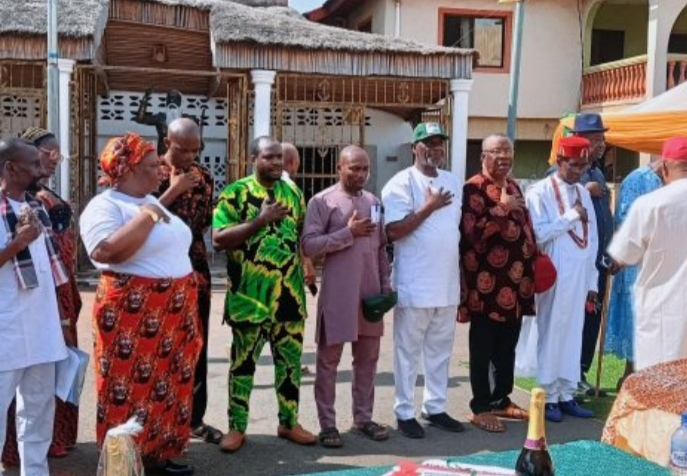
Picture: Inauguration of National Executive Council of Igbochukwu Foundation at ObuGad, Aguleri, Anambra State
BY EGBUNA MUJEKWU, ONITSHA
A new socio-cultural and economic organisation, Igbochukwu Foundation, has been established to promote unity among Ndigbo, preserve Igbo identity and cultural heritage, and advance the socio-economic development of the people.
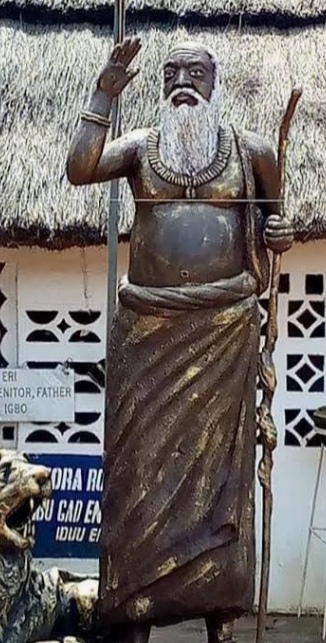
Status of Eri at Obi Gad in Aguleri, Anambra State
The Foundation also inaugurated its Interim National Executive Council at ObuGad, Aguleri, in Anambra East Local Government Area of Anambra State, designated as its national headquarters.
The choice of ObuGad, according to the organisers, was informed by its historical and spiritual significance as the ancestral home of Ndigbo, linked to the traditional account of Eri, identified as a descendant of Gad, one of the sons of Jacob (Israel).
Foundation targets cultural erosion, disunity
Speaking at the ceremony, the National Convener of Igbochukwu Foundation, Dr. Chile Obidigbo, said the organisation was established in response to growing concerns about the challenges confronting Ndigbo and the need for a stronger platform to articulate their collective aspirations.
Obidigbo, an industrialist, said strengthening Igbo identity and unity through shared cultural values, education and responsible leadership was essential to preserving the people’s heritage and contributing meaningfully to national development.
He described the inauguration as an important step towards building an organised platform to address issues confronting the Igbo, particularly cultural erosion, declining social values and concerns about equitable participation in Nigeria’s socio-political and economic affairs.
According to him, the Foundation would promote cultural renewal, intergenerational knowledge transfer and constructive engagement rather than restrict its activities to complaints about perceived marginalisation.
President-General charges Interim Exco
In his address, the President-General of the Foundation, Dr. R.C. Opoko, represented by Professor Johnson Anene, outlined its objectives to include promoting Igbo unity, preserving the Igbo language and cultural heritage, encouraging education and intellectual development, supporting economic empowerment, and expanding the participation of women and young people in leadership.
He charged members of the Interim National Executive Council to demonstrate integrity, transparency, accountability and dedication, stressing that their responsibilities must translate the organisation’s vision into practical programmes and measurable contributions to society.
Opoko also called on traditional rulers, religious institutions, academics, entrepreneurs, professionals and Igbo communities in the diaspora to support the Foundation with their knowledge, resources and experience.
He emphasised that collective participation was essential to cultural preservation and economic advancement.
The President-General stressed that the Foundation was non-political and would pursue its objectives without partisan considerations.
He added that its commitment to justice, equity and self-determination would be guided by peaceful advocacy, constructive dialogue and respect for the rule of law.
Foundation unveils seven historical Igbo provinces
A major highlight of the ceremony was the unveiling of an Igbo map designed by a six-member committee.
Presenting the map, Professor Obasi Igwe disclosed that the committee’s research identified seven historical conceptual provinces associated with Ndigbo.
They are Abia Province, Enugu Province, Ebonyi Province, Anambra Province, Anioma Province, Edo Province and Port Harcourt Province.
He called on Nigerians to embrace the restructuring of the country, stressing the need for a political arrangement that would promote justice, equity and national cohesion.
He said the Foundation was committed to building an enduring institution that would promote cultural continuity, responsible leadership, economic opportunities and peaceful engagement while contributing to Nigeria’s overall development.
Leaders trace Igbo-Israel historical connections
In his remarks, Reverend Daddy Hezekiah underscored the importance of unity, cooperation and the preservation of Igbo identity.
Also speaking, a traditional ruler in Anioma, Delta State, Elder Igwe Vincent Iwobi, traced the traditional account of Igbo ancestry to Israel, describing Eri as the progenitor of Ndigbo.
He cited biblical references, including Genesis 46:15-18 and Numbers 26:16-18, in support of the historical and genealogical connections being advanced by proponents of the Igbo-Israel ancestry narrative.
Iwobi explained that, according to the tradition, Eri and his companions migrated from the ancient land of Canaan to Egypt during a period of famine before eventually travelling through waterways across Ethiopia and Sudan.
He said they arrived at the confluence of the Ezu and Omambala rivers, known as Agbanabo, in present-day Aguleri, where oral tradition holds that Eri received a divine revelation identifying the area as their final destination and settlement.
He also highlighted cultural practices which he said demonstrated similarities between Igbo traditions and biblical customs.
These included Nso Nwanyi (menstruation), which he linked to Leviticus 15:19-20; Ala Obi or Ana Obi (ancestral land heritage), linked to 1 Kings 21:3; Ikuchi Nwanyi (widow remarriage within the deceased husband’s family), linked to Deuteronomy 25:5; and Igba Odibo (apprenticeship), linked to Exodus 21:2.
Others were Iriji Ohuru (New Yam Festival), linked to Deuteronomy 16:9; Ibe Ugwu (circumcision on the eighth day), linked to Leviticus 12:3 and Genesis 17:12-13; and Omugwo, which he associated with post-childbirth purification practices in Leviticus 12:1-4.
Hebrew scholar welcomes growing Igbo unity movement
Contributing, a university Hebrew lecturer and founder/National President of the Organisation of Igbo Hebrew Cultural Heritage International (ORIHCHI), Rabbi High Chief Eduh Eliyahu Soroyah, described the growing clamour for Igbo unity and brotherly relations with the Hebrew people as a welcome development.
The Oguta, Imo State-born Hebrew scholar cited Genesis 14:13, which identifies Abraham as a Hebrew (Ibri), drawing attention to what he described as historical connections between the Igbo and Hebrew identities.
He also observed that Ndigbo were facing challenges similar to those historically experienced by the Jewish people.
Soroyah expressed optimism that stronger unity among Ndigbo, irrespective of the states into which their communities had been politically divided, would help the people overcome their challenges.
The ceremony attracted a cross-section of Igbo leaders, including traditional rulers, religious leaders, academics, chieftains of Igbo-Hebrew cultural organisations, representatives of Ndi Ichie, Ojiana Aguleri and Ndi Otu Ọdụ.
The inauguration marked the formal commencement of the Foundation’s activities, with its leadership expressing determination to build a platform for cultural preservation, economic development and stronger cooperation among Igbo communities at home and in the diaspora.
Tags: Igbochukwu Foundation, Igbo Unity, Aguleri, Ndigbo, Anambra State, Igbo Heritage.