By Ebuka Onyekwelu, PhD
The responsibility for providing and protecting public infrastructure does not rest exclusively on government. Sustainable development requires collective commitment, with government, private individuals and communities working together for the common good.
This is the philosophy behind Governor Charles Chukwuma Soludo’s Public-Private-Community-Partnership (PPCP) model, which is encouraging greater private-sector participation in the development of Anambra State.
A striking example is unfolding at the Anambra State Ministry of Lands office in Onitsha, where two prominent businessmen, Chief Don Ebubeogu and his brother, Chief Celestine Ebubeogu, have committed resources to the reconstruction of a badly deteriorated government facility.
The intervention followed an appeal by the Commissioner for Lands, Professor Offornze Amucheazi, who has been pursuing institutional reforms at the ministry since his appointment in 2022.
In an earlier conversation, Professor Amucheazi expressed his determination to leave a lasting legacy of sustainable reforms at the Ministry of Lands. His vision is reflected in the transformation of the ministry’s headquarters in Awka into a significantly improved working environment.
However, the condition of the Onitsha office remained a major concern to him. He believed that the facility should reflect the standards of institutional reforms and effective governance being pursued by the Soludo administration.
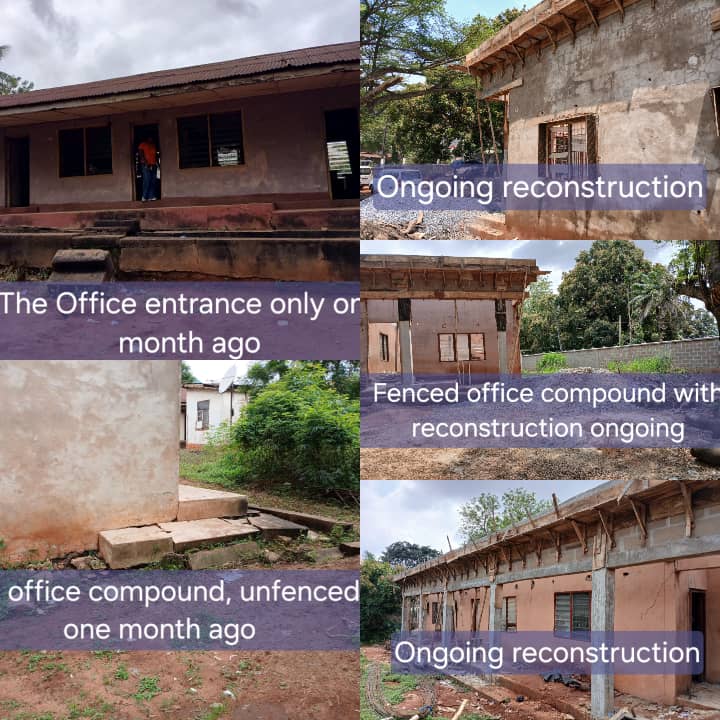
Last month, I accompanied the commissioner to the ministry’s Onitsha office, located in the GRA area of the city. What we encountered was an ageing post-independence-era building that had deteriorated considerably and had become largely unfit for its intended purpose.
Following our assessment, we visited the office of Chief Don Ebubeogu of Tiger Foods. During our discussion, the commissioner made a passionate appeal for intervention, explaining the urgent need to rehabilitate the government facility.
Within minutes, Chief Don suggested that we visit the building. After personally inspecting its condition, he acknowledged the extent of the deterioration and immediately contacted his brother, Chief Celestine Ebubeogu, who also expressed interest in seeing the facility.
About a month later, on Wednesday, I accompanied the commissioner to the same office. What greeted us was a remarkable transformation in progress.
The previously dilapidated government building had become a massive construction site, with extensive reconstruction work underway through the intervention of the Ebubeogu brothers.
This was not a cosmetic renovation or a minor facelift. It was a substantial commitment to rebuilding a public facility through private-sector participation.
The development raises important questions.
Why should Professor Amucheazi be so concerned about an office from which he has no direct personal benefit? Why should private businessmen commit substantial resources to rebuilding government property they neither own nor have any immediate personal use for?
The answer lies in the understanding that the public good does not have to offer immediate personal benefits before individuals can contribute to it. Where an intervention serves the collective interest, it is worth undertaking.
Indeed, remarkable things can happen when visionary leadership meets individuals with a genuine commitment to the common good.
The PPCP model is therefore more than a strategy for mobilising resources to provide infrastructure. It is a call on patriotic individuals to take ownership of their communities and contribute to addressing shared challenges.
A sense of ownership creates a sense of responsibility. Without meaningful collaboration between government and citizens, public property can easily become something distant and abstract, encouraging neglect, misuse and destruction.
When people see public facilities as belonging to someone else, they are less likely to protect them. But when they understand that such facilities belong to everyone, the responsibility to preserve and improve them becomes collective.
This is why the philosophy underpinning the PPCP model deserves attention beyond the immediate construction of buildings, provision of equipment and investment in infrastructure. Its deeper significance lies in promoting a culture of collective responsibility and ownership of public institutions.
Under Governor Charles Chukwuma Soludo, the message is that Anambra is not somebody else’s state, just as government is not somebody else’s property. Anambra belongs to all its people, and its development requires the participation of everyone.
The intervention of the Ebubeogu brothers demonstrates how private citizens can contribute meaningfully to improving public institutions. Similarly, Professor Amucheazi’s determination to rehabilitate the facility underscores the importance of institutional leadership in creating an environment that supports effective service delivery.
The reconstruction is expected to provide ministry staff with a more conducive working environment, improve services to the public and enhance the efficiency of government operations.
Ultimately, the broader lesson is clear: government cannot do everything alone. When leadership provides direction, the private sector contributes resources and communities embrace shared responsibility, development becomes a collective enterprise.
That is the real promise of the PPCP model: building an Anambra where everyone sees public property as their own responsibility and the development of the state as a collective mission.
Tags: Anambra, Development, Soludo, PPCP