

By Christian Aburime
Governor Chukwuma Charles Soludo has declared a state of emergency on environmental degradation in Anambra State, describing flooding, gully erosion, and environmental abuse as the greatest existential threats confronting the state.
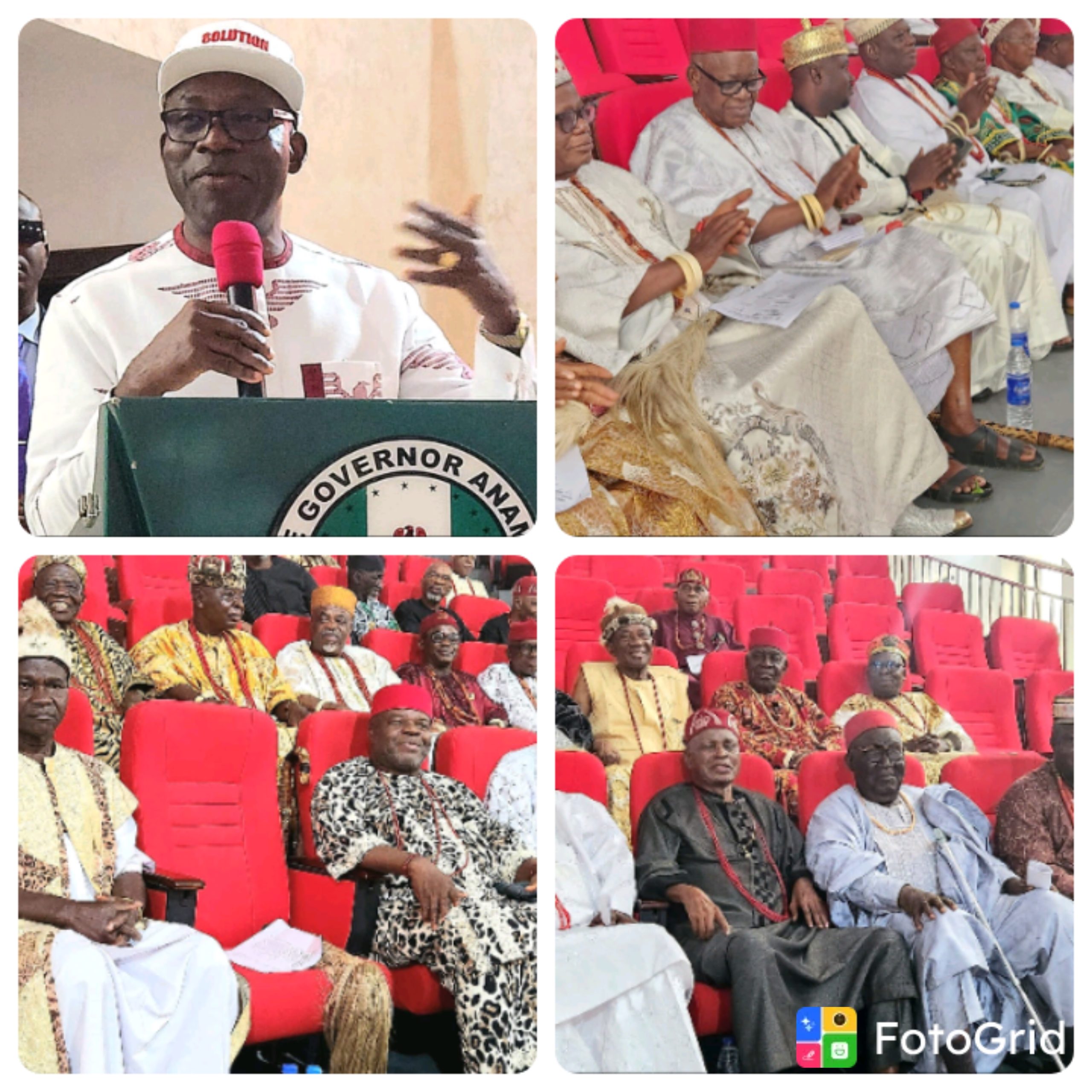
Speaking during a meeting of the Anambra State Traditional Rulers’ Council, the governor ordered the immediate statewide desilting of drainage systems and directed an end to indiscriminate sand mining, warning that both practices are worsening flooding and accelerating gully erosion.
Governor Soludo lamented that Anambra, despite having the second-smallest landmass in Nigeria, is steadily losing portions of its territory to ecological disasters.
“Let me draw your attention to the emergency that we face: the environment, flooding, and gully erosion. It is Anambra’s number one existential threat,” the governor said.
“While Lagos is expanding into the ocean, Anambra is shrinking. Whole communities are being swallowed, and we are battling it. Even if we devote the entire state budget for the next ten years, we will not significantly scratch the surface of this threat.”
Human Activities Worsening Environmental Crisis
The governor blamed several human activities for aggravating the environmental crisis, particularly the blockage of drainage channels, poor waste disposal, and indiscriminate sand mining.
“We blocked the drainages; there should be a state of emergency in desilting all the drainages. Even people that mine sand contribute to this because, as the sand is removed, it creates an avenue for erosion. We all have a duty to protect our environment,” he said.
He also decried the practice of channeling residential runoff water onto roads and dumping refuse into drainage systems, urging communities to embrace responsible environmental practices.
Communities to Become Fourth Tier of Government
On governance, Governor Soludo addressed the implications of the recent Supreme Court judgment on autonomous communities, announcing plans to strengthen community administration through legislative reforms.
According to him, the proposed Community Administration Law will clearly define communities under each local government area and resolve lingering disputes involving town unions.
“The new Supreme Court judgment on autonomous communities in Anambra State settles the matter. Our Community Administration Law will contain a schedule of communities that make up each local government and address most of the tensions surrounding town unions,” he explained.
The governor noted that although town unions currently administer many communities, they remain voluntary associations, a situation that has led to multiple rival unions in some towns.
“When we are done, communities will become the fourth tier of government,” he declared.
Commitment to the New Anambra Vision
Reflecting on the progress of his administration, Governor Soludo contrasted the difficult security situation at the beginning of his first tenure with the relative stability and developmental strides currently being witnessed.
“I want to assure you that we will keep working to deliver on the mandate. Let us continue to push for the new Anambra.
New Anambra is on the rise; we are on course,” he said.
Traditional Rulers Charged on Environmental Protection
The governor called on traditional rulers to mobilize their communities to keep drainage channels free of obstruction and ensure strict compliance with environmental regulations.
Also present at the meeting were the Chief of Staff to the Governor, Dr. Ben Nwankwo; the Commissioner for Local Government, Chieftaincy and Community Affairs, Barr. Vin Ezeaka; the Chairman of the Anambra State Traditional Rulers’ Council, Igwe Chidubem Iweka; and other senior government officials.
Tags: Anambra, Soludo, Environment, Flooding, Gully Erosion, Community Governance


