By David Onwuchekwa
Anambra State’s political landscape in 2025 was largely defined by its off-cycle governorship election, which dominated governance, party activities, public discourse and security considerations throughout the year.
The political season formally gathered momentum in the first half of the year after the Independent National Electoral Commission (INEC) released the timetable for the November 8 governorship election.
Political parties conducted their primaries, producing candidates from major parties including the All Progressives Grand Alliance (APGA), All Progressives Congress (APC), Peoples Democratic Party (PDP), Labour Party (LP) and African Democratic Congress (ADC). INEC subsequently cleared candidates, paving the way for full-scale campaigns.
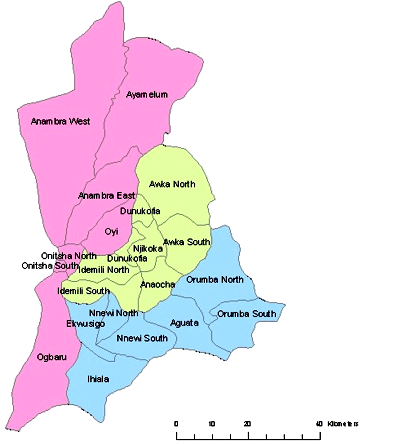
From June, campaign activities intensified across the 21 local government areas of the state. Governor Charles Soludo of APGA sought a second term, campaigning on the achievements of his administration in areas such as security reforms, education, healthcare delivery and infrastructure. Opposition candidates focused on economic revitalisation, industrial growth, insecurity and unemployment, offering alternative policy directions to voters.
Security remained a central issue throughout the year. The state government sustained its crackdown on violent crime and separatist-related activities, while security agencies increased patrols and intelligence operations ahead of the election.
Although most campaign activities were peaceful, isolated clashes between supporters of rival parties were recorded in some communities, raising concerns about political intolerance.
In the build-up to the election, INEC intensified voter education and extended Permanent Voter Card collection to boost participation. Political parties, candidates and stakeholders later signed a peace accord committing themselves to non-violence and respect for the electoral process.
The governorship election was held on November 8, 2025, with voting taking place across the state under heavy security presence. While the process was generally peaceful, there were reports of vote-buying, logistical delays in some polling units and complaints from opposition parties. Election observers acknowledged improvements in security compared to previous elections but expressed concerns over electoral malpractice.
INEC eventually declared Governor Charles Soludo the winner of the election, following a decisive performance across the state’s local government areas. The victory consolidated APGA’s long-standing dominance of Anambra politics and reaffirmed Soludo’s political influence.
Opposition parties rejected the outcome in parts, alleging irregularities, while civil society organisations called for electoral reforms to address persistent challenges such as vote trading.
Beyond the governorship contest, 2025 also witnessed significant political activity with a senatorial bye-election in Anambra South, which further strengthened APGA’s position at the national level. The state government also rolled out new security and governance policies, reinforcing its focus on stability and development.
Overall, 2025 was a politically intense year for Anambra State, shaped primarily by the governorship election, heightened political competition, security concerns and debates about electoral credibility, all of which set the tone for governance and political alignment in the years ahead.