By Amechi Innocent, Abakaliki
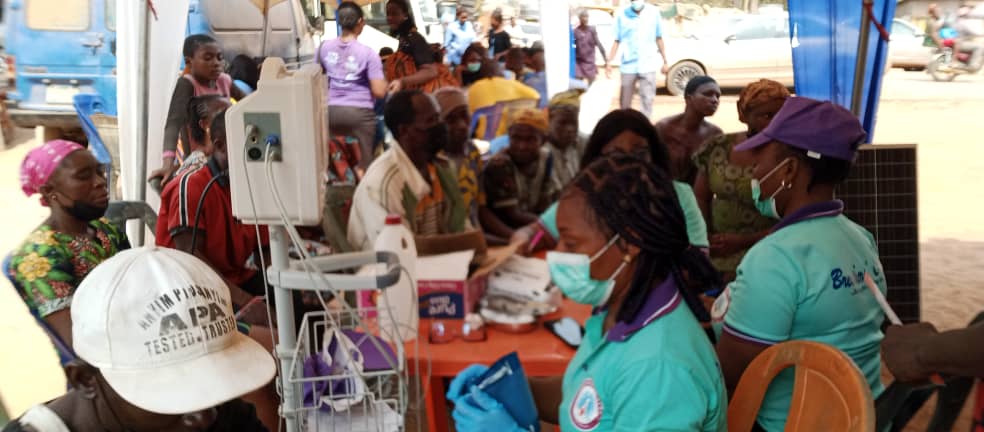
The Equi-Resp Africa Research Project and David Umahi Federal University Health Science, Uburu (DUFUHS) in collaboration with Institute of Child Health (ICH) Alex Ekwueme Federal University Teaching Hospital, Abakaliki (AE-FUTHA) has commenced five days medical screening for free treatment of patients with respiratory diseases in Abakaliki rice mill limited in Ebonyi State.
The programme is targeted at 200 Abakaliki rice millers to be treated free for those diagnosed of the respiratory diseases.
The Vice Chancellor o David Umahi university, Professor Jesse Uneke while speaking during the official flag off of the Equi-Resp Africa Research Project at the rice mill featuring free screening and treatment of respiratory diseases and other health problem challenges.
Uneke said free drugs will be given to the first 200 respiratory disease patients in the rice mill that will be diagnosed and treated
He described Abakaliki rice mill as very critical to the state and Nigeria economy, hence the health program for the rice mill operators and workers to keep them healthy.
“The Abakaliki rice place is very, very critical to the economy, not just Ebonyi State but Nigeria. There is no place in the country that you don’t hear about Abakaliki rice. But we must not forget that these men and women that are here laboring to provide good rice for Nigerians, that their health is also very, very important.
“And so we considered the contribution that the operators of this Abakaliki rice mill have contributed to the development of this country economically.
“And that is why we decided to come here to carry out this intervention to improve the quality of their health so that they can continue to provide rice, good rice, sweet rice for Nigerians. That’s the reason we came here to carry out this intervention on respiratory diseases.
“As you can see, we are here with our team, the Equiresp- Africa team. We came here to do some screening and everyone that we identified with respiratory disease, we treat free of charge. And then we also do sensitization.
“And you can see we went to the place where the rice dust is assembled. And you see a lot of women there. These women, they are playing very critical role in the advancement and the progress of the economy.
“And they must not be forgotten. So that’s why we are here to encourage them to come and do their respiratory screening. So that anyone of them that we find to be having any respiratory disease, we treat them free of charge.
“We made arrangement for complete treatment for the first 200 people. Well, of course, there are thousands of people here.
“But then, it is not every one of them that likely have a respiratory disease. But the first 200 that we are able to diagnose with respiratory disease, we treat them. So we have free treatment drugs for the first set of 200 persons that we present with respiratory diseases”, Uneke said.
He revealed that the Equi-Resp Africa Research Project was also monitoring the air quality in the rice mill apart from the free screening and treatment for the respiratory disease patients in the mill.
The Vice Chancellor said the air quality monitors determine the level of risk associated with the rice mill industry.
” If you say that this place is heavily polluted and you don’t have the data to prove that, you may not be able to do any policy that will be very, very context specific.
“So the idea behind us coming here with air quality monitors is for us to be able to determine the quality of air here.
“And then to be able to ascertain the level of pollution in this place and we quantify the level of risk. That’s the essence of doing that”, the Vice Chancellor said
He explained that the project was generating evidence that government ministries can use to formulate policies that are context specific and policies that can address peculiar health challenges as far as the rice mill is concerned.
“You know, people that are working here and sitting in this place, we also need to deploy interventions that will be very, very context specific.
“And that’s why we are doing this study. To generate information that will help us to now formulate the policies that will specifically address the health challenges that we have in this rice mill”, said Uneke.
The Director, Institute of Child Health (ICH), Alex Ekwueme Federal University Teaching Hospital, Abakaliki (AE-FUTHA), Professor Techla Ezeonu said many people in the rice mill have suffered one form of respiratory diseases or the other which necessitated the health program in the mill.
“We have the intention to bring about equitable healthcare or access to healthcare, we felt that it is important that we reach out to the people of the rice mill community.
“It is really important because their health is necessary. They are working for us, feeding us with rice, but we must also bring healthcare to them. So we are here as every rest on a medical outreach to propagate the message of how to prevent respiratory diseases.
“We also need to possibly diagnose those who have a respiratory disease. We are working with machines, particularly the spirometry machine, that will help us to access the number of patients. For those who have a faulty lung function, we have also free medications for them to treat this disease” Prof Ezeonu stated.