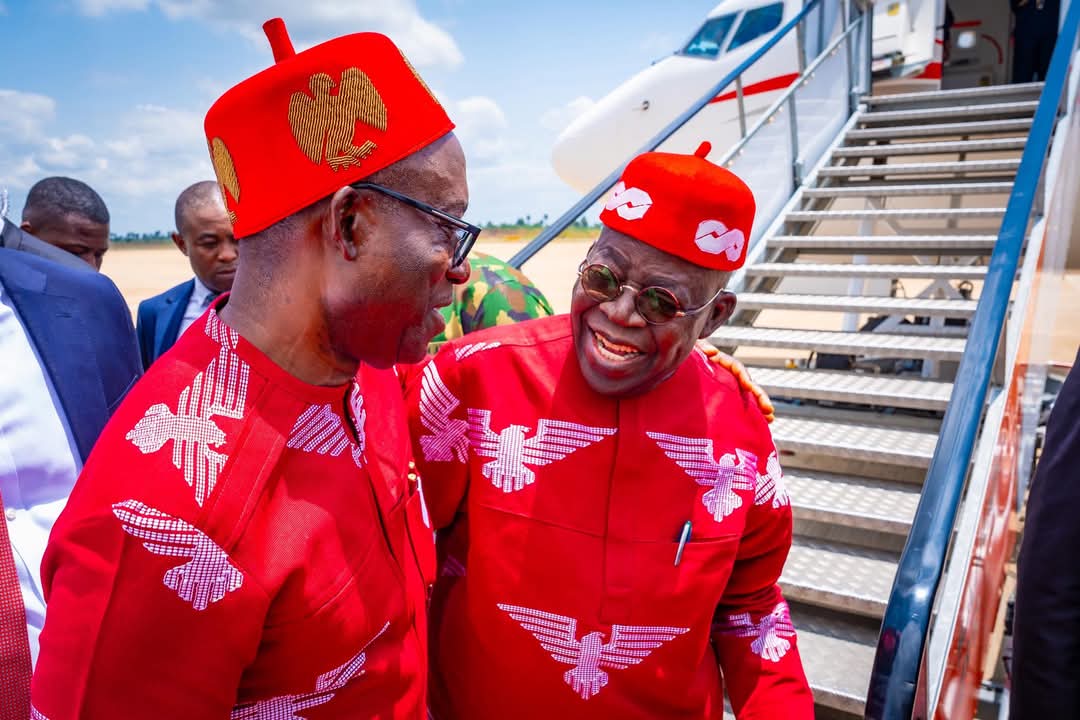
Gov Soludo and President Tinubu
By David Onwuchekwa
The rumour that Governor Charles Soludo may be weighing a move from the All Progressives Grand Alliance (APGA) to the All Progressives Congress (APC) has stirred quiet but intense political conversations across Anambra State.
Whether or not the speculation crystallises into action, it has already exposed the shifting undercurrents in a state whose politics has long resisted full assimilation into Nigeria’s dominant two-party structure.
For Soludo, a defection to the APC would mark the most dramatic turn in a career defined by technocracy and ideological distance from conventional partisan battles.
As a former Central Bank Governor and an economist-turned-politician, Soludo rode to office on a reformist promise anchored more on competence than party ideology. APGA provided the platform, but not necessarily the identity, of his governorship. Moving to the APC would signal a recalibration, less about personal conviction and more about strategic alignment with federal power.
Such a move could strengthen Soludo’s hand in the short term. Aligning with the ruling party at the centre offers access: smoother federal cooperation, greater leverage in negotiations over infrastructure, security and fiscal support, and insulation from the subtle but potent pressures that often confront opposition Governors.
In a political environment where State development is closely intertwined with federal goodwill, the appeal is obvious. Yet, the cost could be steep. Soludo’s image as a different kind of politician, above transactional politics, may suffer, particularly among urban voters and the political class in the South-East who see APGA as a symbol, however imperfect, of regional self-definition.
For APGA, the implications are existential. The party has survived largely because of its grip on Anambra, the last State where it exercises real executive power.
A Soludo defection would not merely weaken APGA; it could hollow it out.
Governors are the lifeblood of Nigerian parties, supplying funding, patronage and relevance. Without the Anambra governorship, APGA risks sliding from a regional force into a historical footnote, its legacy reduced to nostalgia for the days of Chinua Achebe-inspired idealism and the Peter Obi era.
The party would face a brutal question: can it reinvent itself beyond holding office, or was power its only cohesive glue?
Anambra politics itself would enter a new phase. For decades, the State has prided itself on being politically sui generis, electorally sophisticated, resistant to sweeping national tides, and comfortable charting its own course.
A Soludo-led shift into the APC would accelerate the nationalisation of Anambra politics, folding the State more tightly into the ruling party’s orbit. The APC, long struggling to gain authentic footing in the South-East, would claim a psychological victory far beyond Anambra, potentially redrawing the region’s political map.
Yet, such consolidation may also provoke resistance. Anambra’s electorate has a history of punishing perceived political opportunism. If the move is read as self-serving rather than strategic for development, it could energise opposition forces, particularly Labour Party elements and remnants of APGA loyalists, to frame the next election cycle as a referendum on political integrity versus convenience.
Rather than stabilising the landscape, a defection could fracture it further, producing sharper contests and less predictable outcomes.
Ultimately, the Soludo rumour underscores a deeper truth about Nigerian politics: ideology remains secondary to power, access and survival.
Whether he stays or goes, the debate has already revealed the fragility of regional parties, the centripetal pull of federal authority, and the uneasy balance Anambra has long maintained between independence and inclusion.
If Soludo does cross over, it may advance his immediate political calculus, but it would also close a chapter in Anambra’s distinct political story, one where difference was not merely tolerated, but proudly worn as identity.